

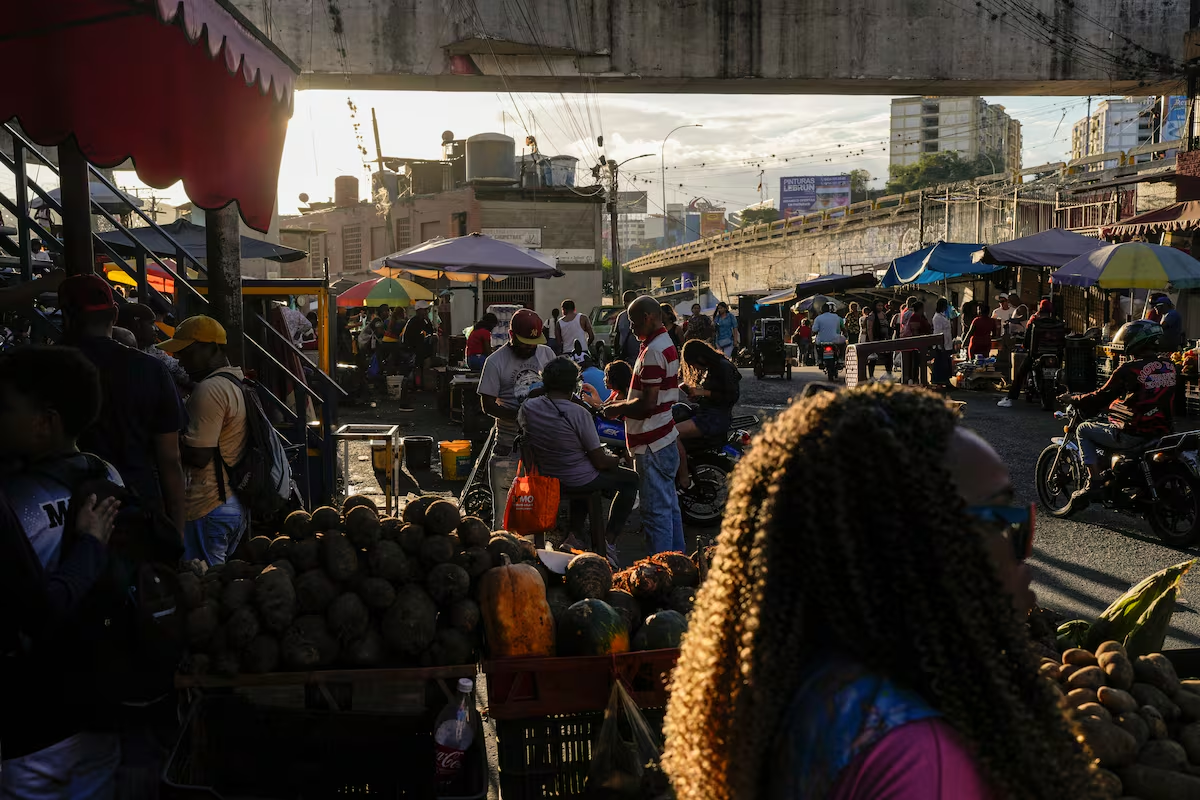
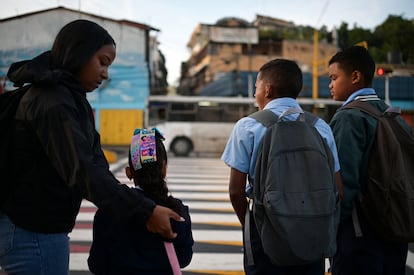
On Monday, January 12, just over a week after the US military operation that arrested Nicolás Maduro and shook Caracas, the children of Venezuela returned to school after the Christmas break. What happened on that unreal early morning of January 3 was not talked about much in the classrooms, but it has been a recurring topic during recess. Venezuelan teenagers are already clear that they can get in trouble for talking too much: in recent months, several have been taken to jail accused of terrorism.
The new normal in Venezuela contains a paradox imposed by circumstances. The capture of Nicolás Maduro, the most powerful man in the country, in a US commando operation worthy of a Hollywood script, has caused astonishment throughout the world and opened a chapter that will be talked about for decades. However, within Venezuela the event remains on hold. This is not the time for analysis or debates about responsibilities: The watchword is silence, caution and a return to basic routines. to guarantee daily subsistence.
Regarding this paradox, although it may seem strange, there is a tacit consensus both among the leaders of the regime and in the population. Chavismo—a wounded movement, but aware that it cannot aggravate its tensions with Washington—needs to project the idea that it maintains political and territorial control of the country. Venezuelan society, for its part, dissatisfied and exhausted, waits while facing economic emergencies and has a long history of contingencies, repression and shortages after years of crisis. Normality is imposed as a forced meeting point.
After a few first hours of nervous shopping and lines at supermarketsthe supply of products has been completely normalized, as has the supply of gasoline. State security forces are stationed in the capitals of the five municipalities of the metropolitan area, installing checkpoints, checking people’s appearance and inspecting cars and cell phones in search of material considered subversive. An intemperate statement about Maduro’s fate in a private conversation may be sufficient grounds for an arrest.
Every day, at nine at night, The political police and military counterintelligence officials take over the city. Many citizens ignore them and remain indifferent to what is happening, but the streets have once again acquired, as in other past crises, a ghostly appearance at the stroke of midnight. Every morning, when they go to work, people find out through WhatsApp chats about the location of the checkpoints to try to avoid them.
“I’ve been around the city a lot these days, resolving personal matters before work starts,” says Enrique Camero, music teacher and resident of the Los Caobos neighborhood. “People are behaving as if nothing had happened. Stores open, people shopping at a hardware store, a guy repairing a car on the street, the condominium board of my building deliberating on a coat of paint that the property needs,” he explains.
The call for this “normality” was made by the Minister of Defense himself, Vladimir Padrino López, one of the pillars of the Chavista regime, just one day after Maduro’s capture. The general expressed the support of the Bolivarian National Armed Forces to the interim president, Delcy Rodríguez, and asked the population to resume “their normal, work and educational activities” in the following days. Interior Minister Diosdado Cabello made a similar call shortly after.
The Chavista militancy has come out on several occasions to demonstrate to demand the return of Maduro, condemn the aggression and denounce US imperialism. At a particularly delicate moment, the ruling party is determined not to “lose the streets,” as many of its leaders usually admit privately. Pro-Government rallies usually occupy avenues in the center and west of the city, reinforced by swarms of motorized vehicles seeking to amplify each call. The state media disciplinedly broadcast these mobilizations, which are also reproduced in the interior of the country. In each protest there are genuinely outraged people, but assistance is required of the entire public administration, with no room for indifference. Despite the deployment, these are relatively modest concentrations, very far from the times of popular drag of Chavismo.
“I work from six in the morning until ten at night, Monday to Friday, and some Saturdays,” says Jairo, a taxi driver who asks that his real name not be published for fear of reprisals. “People from all social strata gather here. As soon as they gain confidence, they start talking about Maduro, gossiping about politics to try to find out something. I haven’t seen anyone upset. In fact, everyone is intrigued.”
At the internal level, Delcy Rodríguez, the president in charge, does what is necessary to make it clear that the regime remains in place and that the legacy of Nicolás Maduro remains. The efforts to secure his release top the daily agenda of Chavismo. Graffiti begins to appear in the streets calling for his release. At the same time, the regime accuses the impact of the coup delivered by the United States and offers new “unilateral” concessions, as Jorge Rodríguez has pointed out when referring to the release of prisoners, with the aim of alleviating international pressure.
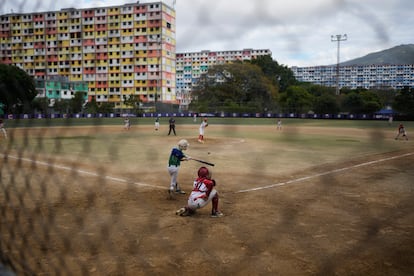
The tone of the Chavista leadership is now less haughty. Calls for serenity multiply. Diosdado Cabello, the most radical of the official leaders, justified the resumption of diplomatic relations with the United States by stating that it will allow them “to have channels to work for the release of Nicolás and Cilia.” In the last official announcement it was reported the release of nearly 400 prisoners politicians since December, among them, as was learned this Wednesday, several journalists.
In parallel, arrests continue. After the US attack, 16 young people were arrested in the city of Barcelona, in the east of the country, accused of terrorism for celebrating Maduro’s capture in the streets. They were released three days later, after a sustained plea from family and friends. Since the outcome of the 2024 presidential elections, the fear of expressing opinions freely has definitively established itself among ordinary people. Now the fear is greater because the “shock” decree in force since January 3 promotes arrests at any sign of joy or protest.
“We have already protested a lot, there are many people here who have seen the devil with the repression,” says Henry Sáez, an accountant who also requests anonymity. “There is nothing more to do but wait. What can people do if for anything you say they can put you in prison?” he asks. “We’re going to wait. I think things are going to continue happening here.”
https://elpais.com/america/2026-01-15/venezuela-ensaya-una-normalidad-forzada-tras-la-captura-de-maduro.html

