

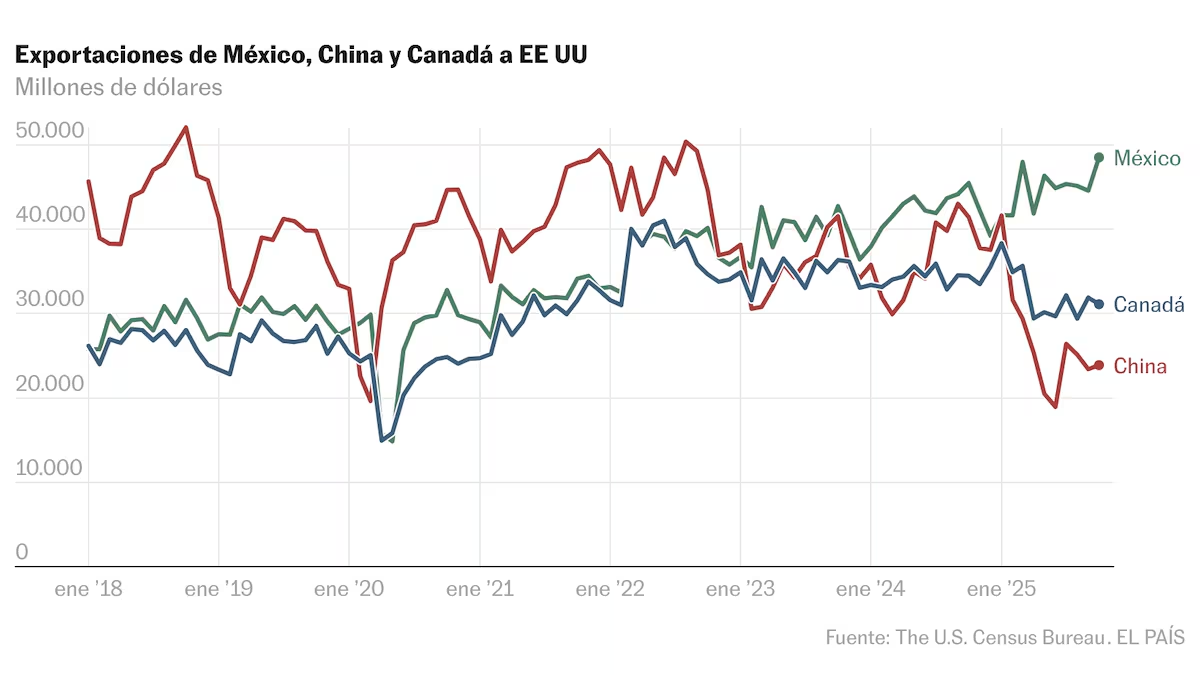
Mexico consolidates itself as the main trading partner of the United States despite the tariffs and President Donald Trump’s threats to blow up the USMCA and to toughen measures against its neighbor if drug trafficking is not combated. In October, the Latin American country surpassed China and Canada as the main exporter of merchandise to the United States with shipments of 48,524 million dollars in October 2025, a record figure, which represents an increase of 6.7% compared to the same month of the previous year. According to US trade figures, in the first 10 months of last year Mexican shipments to Washington exceeded 447,997 million dollars, equivalent to 15% of total US foreign purchases.
Even though Trump has imposed sectoral tariffs against steel and aluminum, as well as products outside the USMCAMexico has managed to overcome these gales and has maintained the upward pace in exports to the US. Official figures show that after Mexico, the main exporters to the US market in the first 10 months of 2025 were Canada with a share of 12.9%; China with 7.6%; Taiwan with 4.3% and Germany with 4.2%. Latin America’s second economy remains the main supplier to the United States, after displacing China in 2023.
On the other hand, sales from the US to Mexico also accelerated the pace in 2025. Until October 2025, US exports to Mexican territory totaled 283,182 million dollars, slightly below the shipments they made to Canada. The US partner in the USMCA also made purchases for 283,846 million dollars. On the contrary, China reported imports from the United States for only 90,912 million dollars in that period. In the midst of the tariff war between these two countries, the Asian giant reduced its purchases from the US market by 18%, compared to the first 10 months of 2024.
Within the vast commercial relationship between Mexico and the United States, Grupo Financiero Base points to an increase in Mexican exports of machines, appliances and electrical material, among other goods. “The increase in chapter 84 is due to the item of automatic data processing machines, that is, computer equipment, which reported a growth of 84% in the accumulated year, compared to the same period last year,” they indicate in a recent report.
Contrary to computer equipment that has been on the rise, shipments of Mexican automobiles and auto parts fell 6.6% in October, going from 153.1 billion dollars to just over 143 billion dollars, according to information from the US Commerce. For years, US assembly companies based in Mexico such as Ford, General Motors or Stellantis have turned the Latin American country into a vital enclave in the assembly of the United States. Mexico must pay a tariff proportional to the non-US content per unit, a factor that, although it has reduced shipments, has not stopped them entirely.
The Mexican authorities assure that, despite Trump’s tariff threat against Mexico, more than 80% of shipments to the United States are free of payment of tariffs because they comply with the requirements of the USMCA, the agreement that will face its maximum review next July and which Trump has described as “irrelevant” for the United States. “We could have it or not, it wouldn’t matter,” Trump told reporters during a visit to a Ford Motor plant this week. In response, the Mexican president, Claudia Sheinbaum, has defended the agreement and North American trade integration: “Our economies are very interrelated. Those who defend the treaty the most are American businessmen, of course, Mexico as well,” she declared.
The issue is not minor. The United States and Mexico have cemented, through the USMCA, a close relationship. For years, the US trade deficit with Mexico has been rising, even despite the tariff wall. From January to October, this deficit for Washington exceeded $164 billion. The large imbalance is one of Trump’s favorite darts to impose taxes on Mexican exports and cast doubt on the USMCA. However, international trade experts warn that, given the productive integration between the two countries, a sustained increase in tariffs will have a counterproductive effect on the US economy by causing an escalation of inflation.
In a recent report, Grupo Financiero Banamex points out that the strength shown by the country’s non-automotive exports could extend due to the greater demand for electrical and electronic goods, favoring the entities producing these goods, located in the North and Bajío. “During 2026, attention will focus on the evolution of the negotiations of the Free Trade Agreement between Mexico, the United States and Canada. The current trade tensions due to the imposition of tariffs on imports by the United States could continue to impact manufacturing production, especially export-oriented production, and importantly transportation equipment production,” he details.
The consensus of analysts, supported by the figures, shows that, so far, Mexico has a better tariff position relative to the rest of the world in the US market. The exemption from tariffs for exports that comply with the USMCA and the geographical proximity that reduces logistics costs are two export strengths for the Latin American country. However, uncertainty prevails and most of the cards regarding the future of this trade relationship will be played in the next review of the North American trade agreement, in July 2026.
https://elpais.com/mexico/economia/2026-01-17/la-fructifera-relacion-comercial-entre-estados-unidos-y-mexico-pese-a-los-aranceles-y-amenazas-al-tmec.html

