

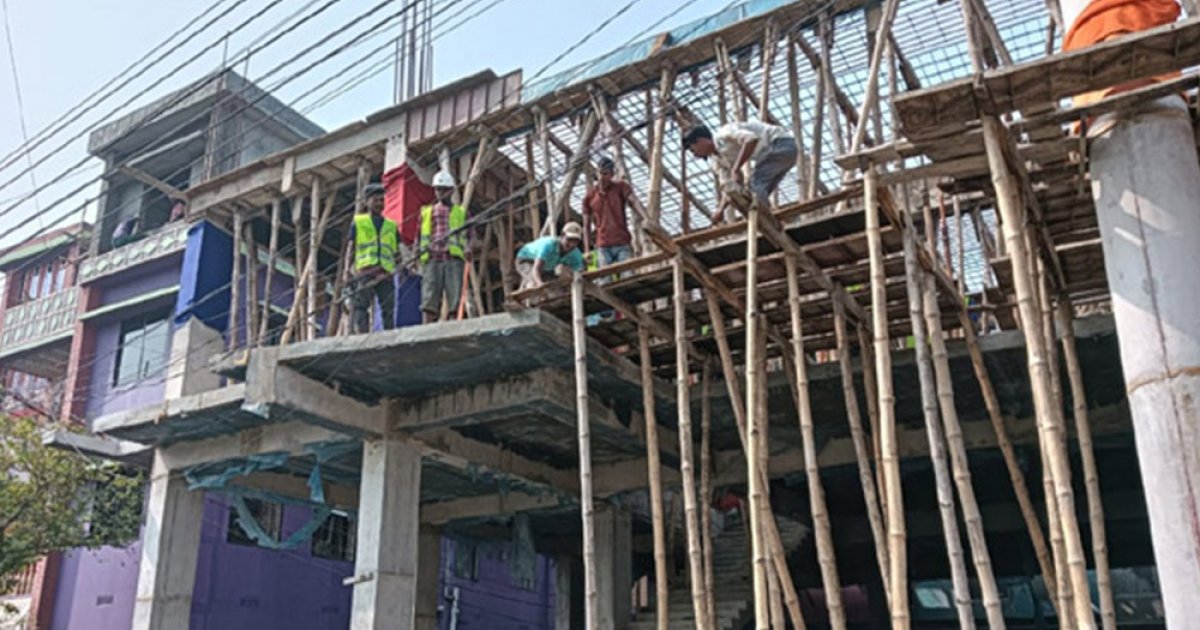
The price of construction material rod and cement has decreased in the market of the country. Since the change of government on August 5, the work of major development projects has stalled due to the student movement. At the same time, this year, the private and private construction works are also progressing slowly due to the long-term disconnection due to floods in various districts of the country. Due to the decrease in demand and sales, the main construction material rod and cement business collapsed. Those concerned said that it will take time for this sector to turn around if the consumption demand does not increase. This information was known by talking to people involved in construction work in different parts of the country including the capital.
Entrepreneurs in the cement and steel sector say that the political change in the country has stopped most of the development projects of the government and the private housing industry has also come to a standstill. This has had a negative impact on the rod and cement markets.
Entrepreneurs also said that after the change of government, most of the contractors involved in the construction work have given up. On the other hand, against bank loans, the interest rate has increased, and production costs have also increased. But due to reduced demand, the additional cost cannot be adjusted. Those involved in these two industries are requesting the companies to provide additional 60-70 percent capital to sustain the industry.
Cement is one of the materials of infrastructure development. It is known that the production of the cement sector is directly related to the government construction projects. The work of various mega development projects of the country is almost completed. Projects that are ongoing; They are closed after August 5. Which has a direct impact on the cement sector. They think that it will take time for this sector to turn around if the consumption demand does not increase even if various problems including imports from the world market and dollar crisis are over.
Sources said that another reason for the halt in infrastructure development is the exclusion of elected representatives of the local government, from the city corporation to the upazila and union level. Although the Union Parishad has not been abolished, most of the union chairmen and members are in hiding. On the other hand, sales and new projects in the housing sector have also decreased due to the ongoing situation in the country and DAP. As a result the sale of rod-cement has decreased. In the current situation, the entrepreneurs of these two sectors are suffering from uncertainty.
They say that sustaining the business is the biggest challenge now. I am not thinking about new investment in this situation.
It is known that in May-June of this year, the price of each ton of rod was more than 90 thousand rupees. At present, rods are being sold in the market at the rate of 86 thousand to 87 thousand taka per ton. On the other hand, compared to May-June, the price of cement has decreased by Tk 20-25 per sack (50 kg).
According to Bangladesh Steel Manufacturers Association (BSMA), there are more than two hundred steel factories in the country. 40 of them are big companies. The company has an annual production capacity of about 10 million metric tons of rods. Although the annual demand of rods in the country is 75 lakh tonnes. So far 75 thousand crores of rupees have been invested in this sector. Annual transaction volume is 70 thousand crore rupees.
According to the Bangladesh Steel Manufacturers Association, the country's companies have a rod production capacity of 12 million tons. Maximum annual demand is 65 lakh tons. 60 percent of this is used in government development projects. The remaining 40 percent is used to build private and private infrastructure. Currently, demand has fallen below 50 percent. The biggest drop in demand is in government projects. Here, the demand for rods has fallen below 20 percent, so prices have been falling steadily.
It is known that the manufacturers are giving special discounts to cement dealers in the last few days. In this, wholesalers and retailers can keep the price 10-15 taka less per bag. However, in this situation, cement producers are worried. Even in the nineties, Bangladesh was dependent on cement imports. However, at that time, the price of clinker, the main raw material of cement, fell abnormally.
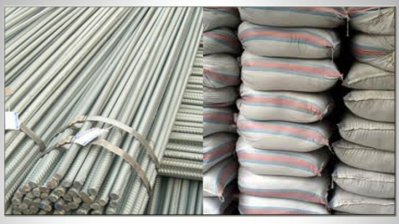 At that time, the import duty of cement was also very high. In this situation, many multinational companies take the initiative to set up factories here. Later local companies came forward to invest in this sector. Early cement production was also very profitable. After 2000, there was a big change in this sector. At that time, the annual demand was 2.5 million tons, of which 90 percent was imported. In the next few years, it can be seen that the production of cement in the country is more than the demand. As a result, at one stage the import of cement was stopped. At present, the annual demand of cement in the country is about 38 million tons. It can be understood that the construction work in the public and private sector has increased a lot. In the 1990s, per capita consumption of cement in the country was only 32 kg, which was 55 kg in 2000 and currently 225 kg. 35 domestic and foreign companies are engaged in cement production.
Prices of rods from different companies
Rods of different companies are now being sold in the market at different prices. It has been seen from the market that Akiz Ispat rod is being sold at the rate of Tk 90,000 per ton this December. AKS Steel Rod 85 thousand 500 Taka, Anwar Steel 85 thousand Taka, ASBRM Steel 81 thousand Taka, Baijid Steel 85 thousand 500 Taka, BSI Steel 80 thousand 700 Taka, BSRRM Steel 88 thousand Taka, CSRM Steel 81 thousand 500 Taka, Dhaka Steel 87 Thousand Taka, Golden Steel 87 thousand 500 Taka, GPH Steel 86 thousand 500 Taka, Hitech Steel 80 thousand 600 Taka, HKG Steel 82 thousand Taka, HRRM Steel 85 thousand Taka, JSRM Steel 79 thousand 600 Taka, King Steel 88 thousand Taka, KR Steel 88 thousand 500 Taka, KSML Steel 88 thousand Taka , KSRM Steel Rs 86 thousand, Metro Steel Rs 85 thousand, MSW Steel 80 thousand 600, PHP Steel 85 thousand 500 Taka, Prime Steel 80 thousand 800 Taka, PSRM Steel 80 thousand 600 Taka, Rahim Steel 84 thousand 500 Taka, RRM Steel 87 thousand Taka, RSRM Steel 85 thousand Taka, S Alam Steel 88 Thousand Taka, Sarum Steel 88 thousand 500 Taka, SAS Steel 87 thousand 600 taka, SCRM steel 81 thousand 500 taka, SS steel 81 thousand taka, SSRM steel 81 thousand taka, Suma steel 81 thousand 500 taka and ZSRM steel rod 82 thousand taka per ton.
Cement price of different companies
It has been seen that a bag of cement weighing 50 kg is being sold at different prices this December. Among them Bashundhara 485, Shah Cement 492, Akiz Cement and Holcim Cement 645, Scan Multi Cement 505, Bengal Cement 475, Eastern Cement 465, Supercrete Cement 490, Premier Cement 475, Scan Cement 525, Tiger Cement 480, Lafarge Cement 520 and Seven Horse cement is being sold at the price of 460 taka.
When asked about this, Secretary General of Bangladesh Steel Manufacturers Association Suman Chowdhury said that after August 5 the approval of government projects has practically stopped. The work speed of ongoing projects is also near zero. This reduced the demand for rods by more than 50 percent. The country's steel and cement sectors are in crisis.
Shahriar Jahan, deputy managing director of KSRM Group, said that we are going through difficult times. I am giving a loss of 24 thousand taka per ton of rod. Now the production cost of 1 ton of rod is 1 lakh 10 thousand taka. But the company is selling the rod at 86 thousand taka.
Statement of Trade Adviser
In this context, trade adviser Sheikh Bashir Uddin said that some contractors are on the run due to political reasons. It is hindering development. Apart from this, some unnecessary projects are being eliminated. This has reduced rod-cement work. We are discussing how to overcome the crisis in this industry.

