

The unsung hero of Bangladesh's economy is the small, micro, cottage and medium (CMSME) sector. It is just a platform for the big dreams of the little ones. Even behind the glittering lights of the big industrial sector, CMSME entrepreneurs are quietly turning the wheel of the economy with their limited capital, tireless work and indomitable innovative power. This sector contributes 38 percent of national income, which is almost double that of large industries. But its importance is not limited to economic indicators. By lighting the light of employment for millions of people, this sector is not only creating a livelihood, but also creating an immense possibility of dreams and self-reliance. CMSME entrepreneurs are like banyan trees—giving shade, bearing fruit, and strengthening the soil with roots.
Still, entrepreneurs in the CMSME sector are struggling every day. Strict credit conditions, harassment to access government services and struggle to stay competitive in product marketing—these are their daily companions. Many enterprises cannot start due to the complexity of water, electricity and gas connections. Again, many people run out of capital while trying to obtain business certificates or approval documents.
When many go to the bank for a loan, they hear, 'There will be no collateral.' They were forced to take money from the merchant at high interest rates. Some give up midway, and for those who survive, every day is a new challenge.
But despite all the obstacles, the entrepreneurs of this sector do not stop. They have an indomitable tenacity and a spark of creativity. A woman entrepreneur started a handicraft in her village, another made bags from a small shop and now dreams of exporting abroad. Thus many more dreams are hidden in the economy, which play a major role in the Gross Domestic Product (GDP) but never come to the fore.
Concerned persons say, now is the time to stand by small entrepreneurs. Banks should offer loans on easy terms and make digital services accessible by reducing administrative hassles. Local and international platforms should be created for product marketing. Small entrepreneurs need a favorable environment to grow. Their success will advance not only them but also the country's economy and prosperity. The emergence of the CMSME sector will strengthen the economy and enable small enterprises to make big changes.
In this regard, National Small and Cottage Industries Association, Bangladesh (Nasib) President Mirza Nurul Gani Shobhan said that it is important to ensure ease of doing business for small entrepreneurs by creating markets, fairs, import-export facilitation, duty exemption and foreign investment. These steps will make it easier for entrepreneurs to run their businesses and contribute more to employment and GDP.
Managing Director of Golden Touch. Fazlur Rahman said that government support is needed for small entrepreneurs and free entry opportunities should be ensured for new entrepreneurs. If the harassment or excesses are stopped, besides meeting the needs of the country, exports will increase, foreign exchange will be earned and lakhs of people will get employment. As a result, small entrepreneurs will be able to make a big contribution to the country's economy.
DCCI President Ashraf Ahmed said, 'Many organizations will not be able to survive without increasing the flow of liquidity in the small and medium industry sector. Therefore, it is important for them to increase the financing opportunities from banks, equity and venture capital.
Current picture of CMSME sector
According to the latest data of Bangladesh Small and Cottage Industries Corporation (BCIC), the number of small, micro, cottage and medium (CMSME) sector entrepreneurs in the country is 7.818 lakh as of June 2023. Out of this number of cottage industry is 68 lakh 42 thousand 884, micro industry 1 lakh 4 thousand 7, small scale industry 8 lakh 59 thousand 318 and medium industry only 7 thousand 106. It should be noted that BSIC has used data from the 2013 Economic Survey as the basis for this information.
Experts related to the sector feel that the actual picture is different and currently the number of entrepreneurs in this sector has exceeded 100 crores. On the other hand, according to the Bangladesh Bureau of Statistics (BBS), the number of large industries in the country is about 6,450. Among them, the number of effective large industries is only 2 thousand 856.
Features cottage to large industries
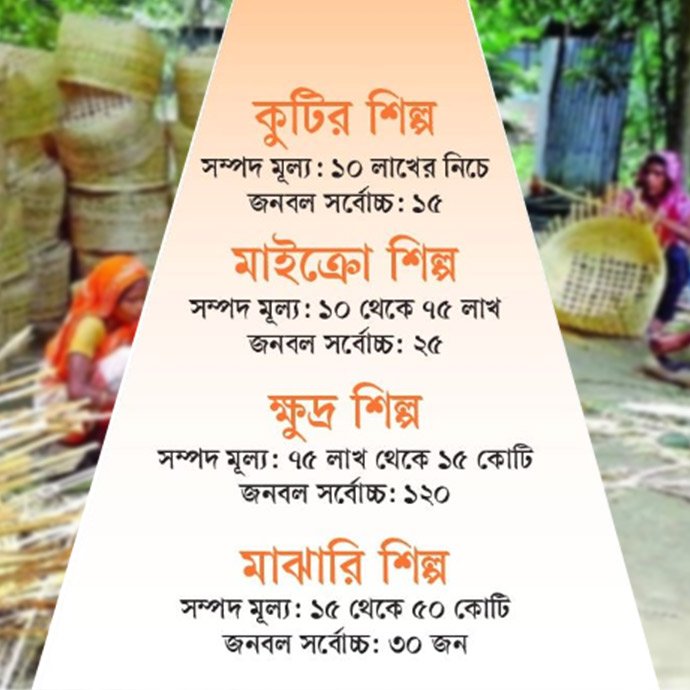
Cottage industries refer to industries whose fixed assets are below 10 lakh rupees and the number of workers is not more than 15. Fixed asset value in micro industry is 10 lakh to 75 lakh taka, number of workers is 1 to 25. Fixed asset value in small scale industry is 75 lakh to 15 crore, number of workers is 26 to 120 people. For medium industries the value of fixed assets is 15 crores to 50 crores and the number of workers is 121 to 300 people. In large industries the value of fixed assets is more than 50 crore rupees and the number of workers is more than 300 people.
Image of bank lending to CMSMEs and large industries
According to Bangladesh Bank, banks have disbursed a total of Tk 3 lakh 61 thousand crore loans to the CMM sector till June 2024. The amount of loans disbursed for this sector is only 21.44 percent of the total bank loans. The disbursed credit to the relatively large industrial sector is about 43 percent, which stands at Tk 710,000 crore.
As shown in the NPL figure, the NPL ratio in the CMSME sector is only 2.93 percent, which is very comforting. On the other hand, in the large industrial sector, this rate is 56.83 percent, that is, 1 lakh 20 thousand crores of disbursed loans have defaulted.
Mohammad Nurul Amin, former MD of NCC and Meghna Bank said, 'Banks always pay less attention to the small and medium sector. Although there are instructions to disburse a fixed portion of loans to the CMME sector, banks often fail to fulfill it, resulting in the deprivation of CMSMEs on the one hand, which hinders progress in the country's overall production and employment. On the other hand, banks are also in danger by giving large loans to adults without considering everything.
The complexity of the small ones to get a loan
Research director of CPD Dr. Khandkar Golam Moazzem mentioned that the commercial banks of Bangladesh give only 18 percent of the total disbursed loans to the country's SME sector. Out of this, small and medium enterprises receive only 9 percent of loans, as a result 91 percent of enterprises are deprived of loan assistance. According to the World Bank, the potential market for SME loans is Tk 26,600 crore.
In the current reality, Bangladesh has directed banks and financial institutions to provide 25 percent of their total loans to CMSME entrepreneurs. There are several low interest incentive and refinancing funds for this sector. However, due to various complications including business certificate, annual report, SME entrepreneurs are not able to meet the target of loans and incentive loans.
Safina Akhter, owner of Binus Crafts and Designs, said, 'Small businesses face many hurdles. Keeping up with the elders requires manpower and other resources, which we do not have. Applying for a bank loan requires documents and collateral, which is difficult for small firms to obtain.'
Tarekul Islam, managing director of Kishanghar Agro, said, 'Our bank loan experience is very bad. Even showing assets of Rs 2 crore, SMEs or agriculture loans are not available. Banks are not keen to lend in different ways.'
90 percent of industries in the country are cottage industries
Although 90 percent of the enterprises in Bangladesh are cottage industries, banks are not interested in lending to them. They are mainly focused on lending to large institutions. This situation can be dangerous for the country's economy. Economists believe that increasing credit to the CMSME sector will increase the pace of the country's economy and increase employment.
Bangladesh Bank's former Chief Economist Mustafa K Mujeri warned that the country's economy will not be able to move forward properly if small companies do not survive. He said, banks should adopt new methods to increase credit opportunities for small businesses.
Former president of FBCCI. Jasim Uddin said, about 40 percent employment is being created in the SME sector. He pointed out that if SME entrepreneurs get loans on easy terms, they can expand their business, which will create new entrepreneurs and increase employment.
Vice Chairman of Bangladesh Export Development Bureau (EPB). Anwar Hossain said, 'Although excellent policies have been formulated for SMEs, there are weaknesses in their implementation. The SME policy has been tasked with creating new market growth and export potential, but stakeholders are lagging behind in acting accordingly.'
Anwar Hossain Chowdhury, MD of SME Foundation said, 'Government's financial and project support is not available for SME development. There is a budget of 2 thousand 141 crore rupees for the implementation of the SME policy of 2019, but no money has been allocated.
Suffering from lack of policy support
According to BCIC sources, the total investment amount of CMSME sector organizations under BCIC is 56 thousand 455 crores. 887 of these invested enterprises are export oriented industries. However, due to failure to adapt to the changed situation after coming into production, the number of sick and closed factories has stood at 357 from among the domestic and export-oriented companies till last June. In this regard, Bangladesh Knitwear Manufacturers and Exporters Association (BKMEA) President Mohammad Hatim said, 'Because of the country's economy, politics and lack of policy support from the government, some parts of these industries are sick and some have closed.

