

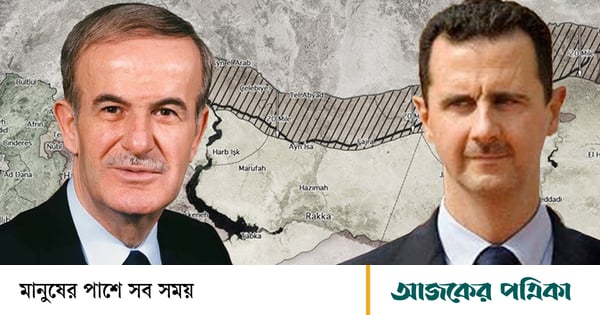
The Syrian capital Damascus has fallen to the government of President Bashar al-Assad. Al-Assad left Damascus on a plane to an unknown destination, Reuters reported. With this, almost 54 years of rule of the Al-Assad family in Syria has come to an end.
Bashar al-Assad's father, Hafez al-Assad, was president of Syria from 1970 until his death in 2000. He turned the country into a sort of prison using military dominance, political maneuvering and brutal repression.
Born into the Alawi or Alvi sect of the Shiite sect, Hafiz al-Assad strengthened his position in the Syrian military early in life. He became particularly influential during the country's communal power struggle in the 1960s.
He was later appointed as Syria's Minister of Defense and Commander of the Air Force and played an important role in the Baath Party's internal power struggle in 1966. Then on November 13, 1970, he seized power through a bloodless coup. It was the 10th military coup in Syria in 17 years. But the coup brought a kind of 'fragile' stability to the country.
Assad used the Ba'ath Party as a shield to consolidate his power and appointed members of the Alwi community to key military and intelligence positions, particularly in the special forces and armored forces. When Muslim extremists revolted in Hama in 1982, Hafiz al-Assad's forces launched a brutal crackdown. It destroyed a large part of the city and killed thousands of civilians.
Although Hafez al-Assad's regime was notorious for its repression, many Syrians praised the relative stability and order during his rule. The country has been suffering from almost continuous unrest since independence. Hafiz ruled the country by issuing emergency decrees for more than three decades. His rule was both feared and admired by some. After his death in 2000, Syria came under the control of his son Bashar al-Assad.
Bashar al-Assad followed in his father's footsteps by assuming power. He ruled the country with relative ease until the start of the Arab Spring in 2011. However, when he was ousted in 2011 in suppressing the Arab Spring, a rebellion against him erupted and soon turned into a civil war.
Until 2012, Syria's constitution stated that the Ba'ath Party was the country's ruling party, and presidential elections only confirmed popular support for the incumbent president. Although currently the country's constitution states, the political system should be defined by multi-party and democratic elections.
Syria's parliament was long held by the Baath Party and its ally, the National Progressive Front. Although it is theoretically possible to form another political party, in practice no political opposition is allowed. According to the Constitution, Parliament is considered as a legislature but has no real effect. Real power is concentrated in the hands of the al-Assad family, the country's security establishment and an economically privileged elite.
Under the Syrian constitution, Bashar al-Assad was supposed to remain in power until 2028. But recently the rapid advance of the rebels and the failure of the government military under his leadership hastened his downfall. When mass protests for democracy erupted in Syria in 2011, al-Assad's regime responded with brutal and widespread violence against protesters. The United Nations later labeled it a crime against humanity. Since 2012, the government has regularly attacked civilian facilities, including hospitals and schools, and used chemical weapons against its own population to quell opposition.
Bashar al-Assad's regime has paid a heavy price for those who are playing a courageous role in demanding democracy, freedom of expression and justice in Syria. Around 1 lakh people have gone missing since 2011, victimized by themselves or their family members because of the movement or simply because they were suspected of belonging to the opposition.
Not only that, the Syrian civil war since the Arab Spring 13 years ago has so far killed more than five million Syrians and displaced millions from their homes. The conflict involves domestic opposition groups, extremist groups and international powers including the US, Türkiye, Iran and Russia. In the end, however, Bashar al-Assad's allies failed to protect him.
References: AFP, Reuters, India Times and Civil Rights Defenders
Read more:

