

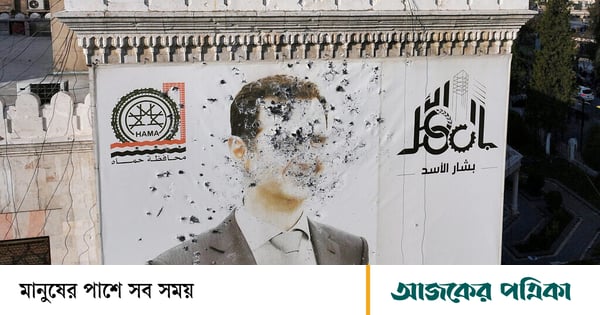
Rebels have entered Damascus, the capital of Syria. In the outskirts of the capital, the sound of gunshots is heard every now and then. Meanwhile, President Bashar al-Assad left Damascus on a plane to an unknown destination, Reuters reported. Reuters reported this information citing two senior Syrian officials.
Apart from this, other international media have reported that Bashar al-Assad has left the capital. However, no one could give an idea about the destination of Asad. The UK-based Syrian Observatory for Human Rights also reported that Assad was believed to be on the private plane that left Damascus airport. Government troops at the airport were evacuated after the plane took off, they said.
The anti-Assad movement in Syria that started in 2011 subsided, but at the end of November last year, the rebels started a new attack and quickly advanced towards the capital Damascus after winning Aleppo, Hama, Homs. The rebels claimed that Bashar al-Assad had fallen within a week of the start of the offensive.
Meanwhile, discussions have begun on what hastened the downfall of Bashar al-Assad. David Des Roches, an associate professor at the US think tank Near East South Asia Center for Security Studies, attributed the success of the Syrian rebels' rapid offensive to the Syrian army's 'lack of morale and leadership'.
Roches told Al-Jazeera, a Qatar-based media outlet, 'Since the intervention of Iranian and Russian forces in 2014, we started to hear that the Syrian Arab Army (Syrian government forces) was not being properly led. They are more focused on extorting bribes from the civilian population than fighting. The actual war was being waged mainly through various proxy forces supported by Iran. The Russian Air Force was supporting these proxy forces.'
The analyst also said, 'After Russia withdrew its air force support, Iran-backed proxy forces became unable to fight. After that, only a demoralized, poorly led, inadequately equipped and thoroughly corrupt armed force is left to fight. People are not ready to take risks in such situations.'
In addition, insurgent groups have received tacit, if not direct, support from Turkey. The Turkish president publicly wished the rebels success. Last Friday, Erdoğan said, '…Idlib, Hama, Homs and of course the target is Damascus. The march of opposition continues. Our wish is that this progress in Syria will continue without accident or disaster.' Expressing dissatisfaction with the Syrian leadership, he said, 'We called on (Bashar al-) Assad. I said, let's decide the future of Syria together. Unfortunately we did not get a positive response.'
In March 2011, the beginning of instability in Syria with mass protests against Assad. After that, several armed rebel groups joined there. Later, Assad retained control of the capital by suppressing those rebellions.
Syria is still a divided country, with the deep wounds of years of civil war still burning. The stalemate and stability that had prevailed for the past four years had completely broken down only a week and a half ago. The rebels suddenly struck hard, leaving Assad forces unable to mount a counterattack or resistance. Assad emerged from a reclusive position among Arab leaders. But the post-war period has seen little progress in building a viable future for the Syrian people.
Read more:

