

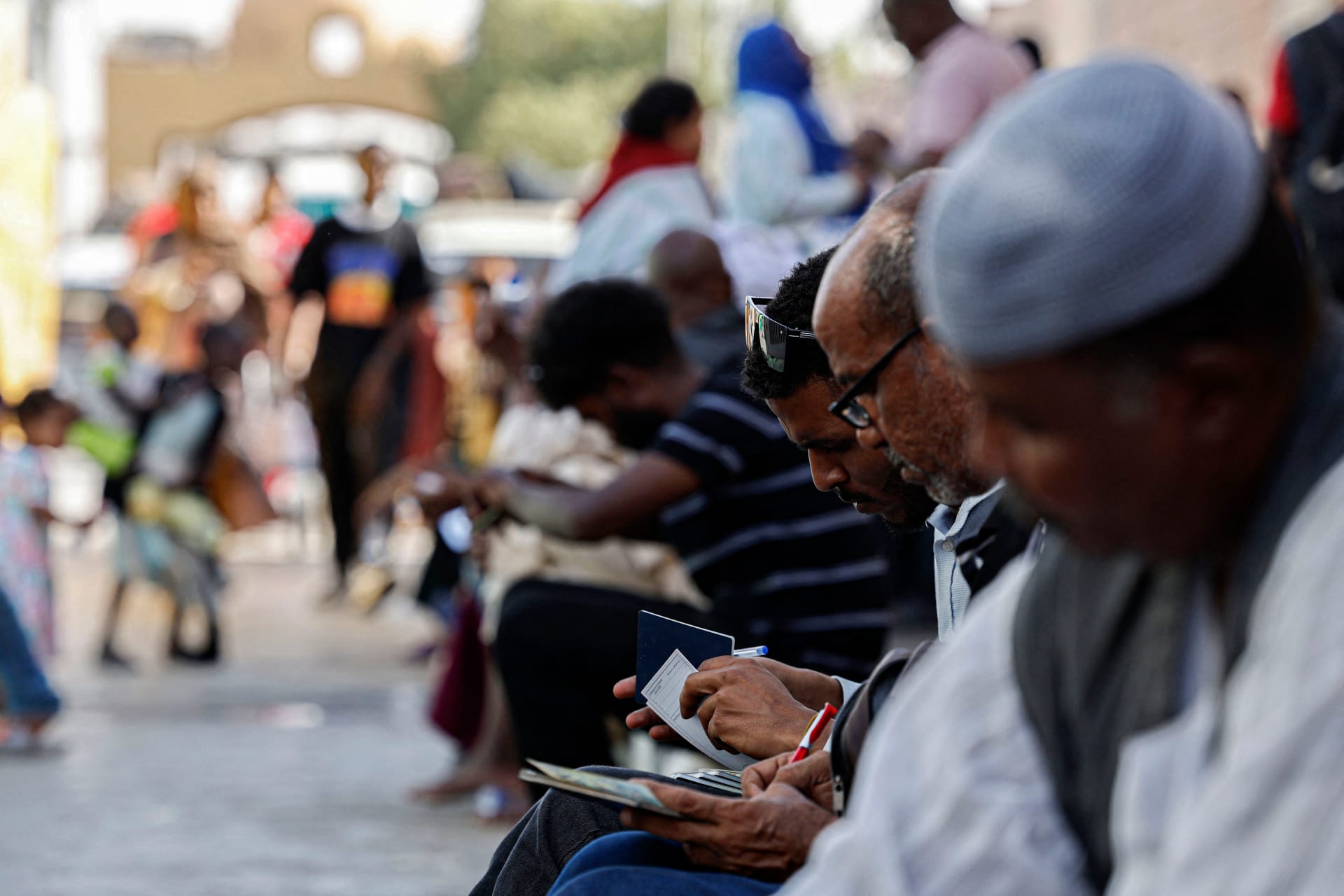

Arab FinanceDuring its plenary session this week, the House of Representatives finally approved a draft The new foreigners' asylum law Which was presented by the government with the aim of legalizing the conditions of refugees, which aims to establish a legal regulation of the conditions Refugees Their various rights and obligations within the framework of the rights and obligations recognized by international agreements.
The new foreigner asylum law includes the formation of a permanent committee for refugee affairs affiliated with the Council of Ministers, which is responsible for collecting data and statistics on the numbers of refugees, as well as adjudicating asylum applications, to be the authority responsible for all refugee affairs, within the framework of continuing to provide full support and assistance to refugees.
Researchers in immigration and refugee affairs have called for the necessity of integrating refugees in Egypt into economic activity so that they can be active and productive members of society, especially with the economic conditions that Egypt is currently experiencing, and the burdens and pressures on resources allocated to vital sectors such as health and education, while others have warned of some effects that may It is negative for Egyptian society, and it relates to some traditions that are foreign to Egyptian society and can be transmitted to it despite the state’s fight against them, such as early marriage and female circumcision.
The new asylum law is a reflection of Egypt's international obligations regarding refugees
Dr. Ayman Zohri, founding president of the Egyptian Society for Migration Studies, and professor of migration studies at the American University in Cairo, said in exclusive statements to Arab Finance that the new asylum law in Egypt was long overdue, as it should have happened after Egypt signed the United Nations Convention relating to the Status of Refugees in 1983, and thus The issuance of this law was delayed by about 41 years, but in light of the economic pressures of the state and the large immigration flows coming to Egypt, there had to be a pause, and Egypt should have full sovereignty in determining the status of Refugee, as Egypt voluntarily conceded to the United Nations High Commissioner for Refugees to grant refugee status, and this right had to be returned to the sovereignty of the Egyptian state.
Zuhri, a member of the National Council for Human Rights, added that the presence of a technical secretariat for refugee affairs will control matters related to refugee affairs in Egypt, and will make the United Nations High Commissioner carry out its inherent role, which is related to protecting refugees in the event that any refugee is exposed to something that affects his protection.
Zuhri explained that the new asylum law is a reflection of Egypt’s international obligations related to international conventions and agreements for refugees. Rather, Egypt gave more rights to refugees than what was stipulated in international agreements, noting that the Global Compact for Refugees stipulates the necessity of sharing burdens, which requires that the international community play its role in supporting… Egypt receives refugees.
Economic integration of refugees
For her part, Rabha Seif Allam, an expert in refugee affairs at the Al-Ahram Center for Political and Strategic Studies, said in exclusive statements to Arab Finance that the issue of economic integration of refugees in Egypt is a very important issue, as some refugees suffer from the burden of expenses, as they are no longer paid living allowances due to the meager resources allocated to them. On the part of the United Nations, with the decrease in donations from donor countries, it has become necessary for refugees to go to work and production, and here the new law comes to regulate the already existing reality, not to create a new reality.
Allam, who won the State Encouragement Award for the year 2019 for her research on the conditions of refugee women in the Arab world, added that the new refugee law in Egypt deals with foreigners in Egypt in general and regulates the mechanisms and controls for work or requesting residency or even citizenship, and it mainly targets refugees who have decided to remain in Egypt and not Who use Egypt as a transit point to a third country.
Allam explained that the issue of regulating the work of refugees in Egypt is very important, because it protects them from exploitation by employers when their work is registered and monitored by the state, and at the same time allows the state to collect the taxes and fees imposed on this work.
Allam pointed out that there must be a link in order to direct refugees to work based on their competitive advantage in a way that does not threaten the Egyptian job seeker. For example, we have witnessed the opening of markets, stores, restaurants and bakeries for Syrian and Sudanese refugees, and this does not necessarily threaten the Egyptian provider of the same service, but rather It increases the quality of service provided due to the presence of competition, and thus the Egyptian consumer will benefit in the end.
Guiding job seekers
Allam stressed the importance of job seeker guidance programs, which redirect refugees to practice specific craft professions or encourage them to open a private business, in order to diversify job opportunities for them without cutting into the Egyptian labor market, and thus be an addition to economic activity and not a deduction from the basic economic space.
There must be international support for Egypt
Dr. Hanan Girgis, Vice President of the Egyptian Center for Public Opinion Research “Baseera” and an expert in the field of population issues, said that it is necessary for the international community to come together to help Egypt receive all these numbers of refugees and immigrants, especially with the pressure on the state’s economic resources and the services provided, which It already has crises, including health and education, which suffer from a deficit. For example, we have low indicators related to the citizen’s share in health services, as there are 8 doctors for every 10,000 citizens, and these rates are much lower than the average. In addition, we are suffering from a crisis of doctors migrating abroad, and in addition to the issue of the deficit related to health services, there are educational services, in which we suffer from overcrowding in classrooms, and therefore the outside world, especially European countries, must stand with Egypt and contribute to supporting Egypt financially to deal with these large numbers of refugees. In light of the turbulent situation in the Middle East and the Arab region, because in reality it is unfair for Egypt to bear all these burdens alone.
Girgis explained that there are many fears related to culture and traditions and the transmission of customs that are alien to Egyptian society or the return of customs and traditions that are being combated by the state, such as female circumcision, for example, in which Egypt has achieved a great achievement and breakthrough, as there are many Sudanese refugees coming to Egypt who perform female circumcision and it was discovered recently. A medical clinic for a Sudanese doctor in Giza Governorate who performs female circumcision in violation of the law, in addition to early marriage for girls, all of which are customs that the state resists and in which significant progress has been made, and therefore there must be a way to integrate them into Society without any negative impacts on the culture, customs and traditions of Egyptian society.
Numbers of refugees in Egypt
Egypt hosts more than 792,000 registered refugees and asylum seekers of 62 different nationalities, and since October 2023, Sudanese nationality has become the most numerous, followed by Syrian nationality, followed by smaller numbers from South Sudan, Eritrea, Ethiopia, Yemen, Somalia, and Iraq, according to the official website of the High Commissioner. United Nations Refugee Agency.
The Commission reported that, as of September 30, 2024, the number of refugees registered with the Commission had reached 503,993 refugees from Sudan, 158,406 from Syria, 46,59 from South Sudan, 39,768 from Eritrea, 18,685 from Ethiopia, and 8,661. From Yemen, and 8476 from Somalia, 5,719 from Iraq, and more than 54 other nationalities.
A study by the International Organization for Migration and data issued by the United Nations Office in Cairo in August 2022 reported that immigrants in Egypt contribute positively to the labor market and the growth of the Egyptian economy, explaining that Syrians, who constitute 17% of the number of international immigrants in Egypt, are considered among the best nationalities that contribute in a way. Positive in the labor market and the Egyptian economy.
According to government data, the number of refugees in Egypt has reached more than 9 million from about 133 countries, representing 8.7% of the country’s population.
Prime Minister Dr. Mostafa Madbouly pointed out several months ago that the Egyptian state costs $10 billion annually to receive these refugees.
According to Dr. Khaled Abdel Ghaffar, Minister of Health and Population and Deputy Prime Minister for Human Development Affairs, there are about 9 million immigrants and refugees living in Egypt from about 133 countries, with 50.4% males and 49.6% females, with an average age of 35 years. They represent… 8.7% of Egypt’s population, pointing out that 56% of them reside in 5 governorates: Cairo, Giza, and Alexandria. Dakahlia and Damietta. There are 60% of immigrants who have been living in Egypt for about 10 years, and 6% have been living integrated into Egyptian society for about 15 years or more, in addition to the fact that there are 37% of them who work in stable jobs and stable companies.
While an official statement issued by the International Monetary Fund stated that the increasing number of refugees adds to the financial pressures on public services, especially health and education, adding that Egypt, in the face of this difficult external environment, has implemented major reforms to maintain macroeconomic stability, and the unification of the exchange rate since… In March, to eliminate the backlog of demand for foreign exchange and ease imports, the central bank affirmed its commitment to maintaining a flexible exchange rate regime to protect the economy from external shocks.

