

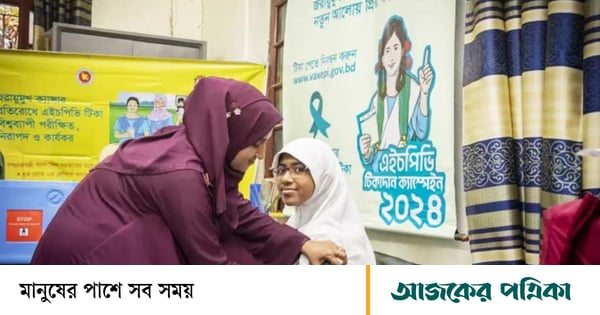
5.6 million teenage girls in Bangladesh have been vaccinated against HPV, including those from the most marginalized communities. The vaccine alliance GAVI, UNICEF and the World Health Organization announced this information in a joint press release on Wednesday (December 11).
According to the notification, HPV vaccination was started in Barisal, Chittagong, Khulna, Mymensingh, Rajshahi, Sylhet and Rangpur divisions on October 7 this year. The target was set to vaccinate 62 lakh girls across the country. But 5.6 lakh girls have been vaccinated, which is 93 percent of the target. Vaccination is provided free of charge to students of classes V to IX and girls aged 10 to 14 years who are out of school.
Cervical cancer is caused by a common virus (HPV) and is one of the leading causes of death among women worldwide as well as in Bangladesh. More than 5 thousand women die of cervical cancer in Bangladesh every year. But this deadly cancer is preventable. The first step is to require all women to get the HPV vaccine at puberty.
Studies have shown that cervical cancer has decreased by about 90 percent among those who received the vaccine. Medical experts in Bangladesh have been talking about the importance of HPV vaccination since 2008, and in the past few months that dream has come true. Apart from this, regular health check-ups should be ensured for all women, including those who have not been vaccinated, to ensure prompt treatment by detecting the virus in its early stages of creating cancer cells.
Rana Flowers, UNICEF representative in Bangladesh, said, 'This milestone of 93 percent HPV vaccination has been achieved under the leadership of the EPI program of the Ministry of Health and Family Welfare and the Directorate of Health Care. I thank them for this.' He further said, 'As this vaccine is being included in the routine immunization program from next year, it is an important step towards eliminating this preventable cervical cancer.'
Sam Muller, head of Euro Asia-Pacific at Gavi, The Vaccine Alliance, said, 'By providing the HPV vaccine to 5.6 million girls in marginalized and disadvantaged communities, we are not only saving lives, but empowering an entire generation to thrive.'
To make the HPV vaccination program a success, the Interim Government as well as GAVI provided financing to ensure adequate logistics for vaccine procurement, supply and implementation of the vaccination program. And UNICEF has worked with WHO and the Interim Government of Bangladesh, as well as national and local stakeholders, to ensure the overall planning, monitoring and implementation of HPV vaccination programs to reach the marginal level.
Continuous daily monitoring and analysis of progress from the district and upazila levels enables the Department of Health Care to identify lagging areas and provide additional support and attention.
World Health Organization representative in Bangladesh Dr. Ahmed Jamshid Mohamed said, 'This success of the HPV vaccination program proves the strength of the ministries working at the national and regional levels, community leaders and volunteers working together. Timely steps to rebuild trust by addressing initial challenges like rumors and reluctance to take vaccination, enabled us to achieve 93 percent coverage success. Our development partners, including the WHO IVD Network, have played an important role by providing technical and technical support, assisting in program implementation and continuous monitoring. This milestone is not just an EPI or immunization programme, but a united commitment to protect future generations from preventable diseases like cervical cancer.'
Sam Muller, head of Euro Asia-Pacific at Gavi, The Vaccine Alliance, said, 'By providing the HPV vaccine to 5.6 million girls in marginalized and disadvantaged communities, we are not only saving lives, but empowering an entire generation. Our sincere congratulations to all the dedicated health workers and communities involved in this program who made it a success.'

