

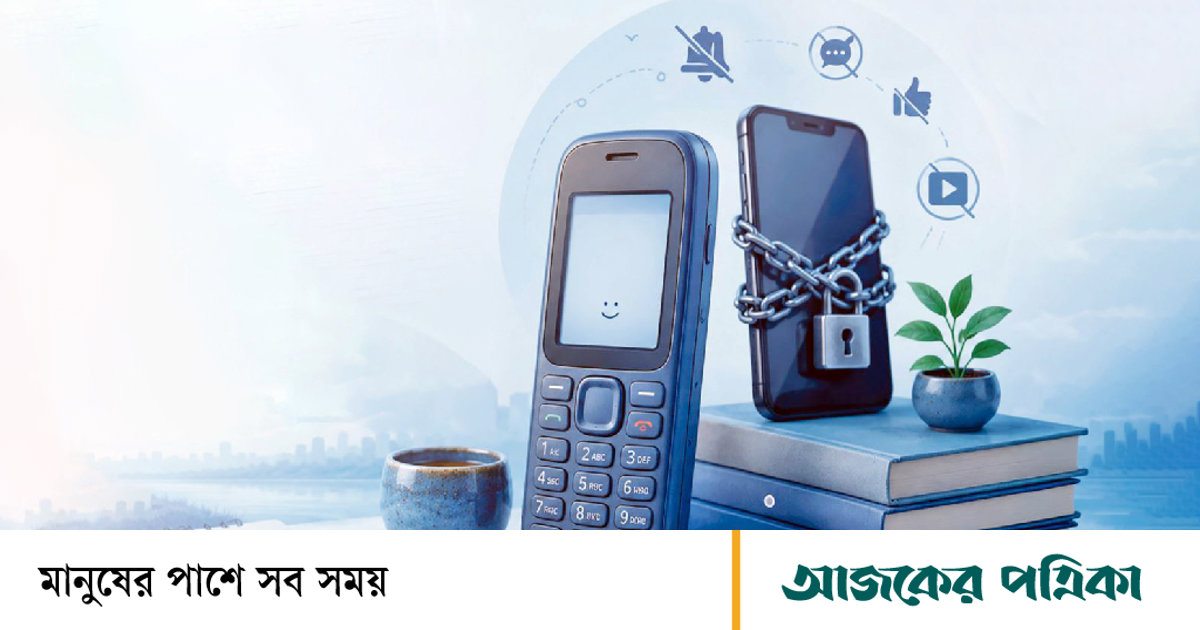
From waking up at the sound of the alarm in the morning to the last scroll in bed before going to sleep at night! The 24-hour routine of people of this era is now captured on a glass screen of five to six inches. Our focus, sleep and peace of mind are being lost every day in the endless maze of Facebook notifications, Instagram reels and YouTube shorts. It is precisely this suffocating technology dependence that has now begun to tell the story of a silent comeback around the world. The young generation is now turning towards a ‘digital detox’, giving thumbs up to the world of artificial intelligence and hi-tech gadgets. And the big tool of this disobedience has become the old, simple button mobile phone, which is now known in the global market as the dumbphone.
Gen-G in reverse current
The generation that was born and raised on the highway of internet speed and smartphones, is now panting more. According to a recent global survey by market research firm Counterpoint Research, sales of classic feature phones like Nokia or Motorola have grown significantly in the US and European markets over the past two years. This trend is more common among high school and university students.
Why this reverse journey? According to psychiatrists, an average young person spends 7 to 8 hours a day staring at a screen. This extra ‘screen time’ disrupts the normal release of dopamine in the human brain. It has a direct impact on their mental health. Increasing depression, attention deficit and severe loneliness. To avoid this mental fatigue or digital burn out, young people are now locking smartphones in drawers. They are choosing mobile phones that can only be used for urgent calls and text messages.
Fashion statement vs known reality
A group of students from Brooklyn, New York recently formed ‘The Lodite Club’. The members of this club have pledged that they will not use any smartphone in their daily life. They have all gone back to flip phones or dumb phones with buttons. For the youth it is now not just a means of peace of mind, but a ‘cool fashion statement’ or a different lifestyle.
Abdullah Al Imran (22), who works in a private company in Dhaka, shared his experience and said, ‘Three months ago, I noticed that while scrolling, it was 3 am, I don’t even know. Headache in the morning
He woke up tired. Then buy a simple button phone. Now I can focus on work by reducing my addiction to social media, I enjoy chatting with friends more than virtual like-comments.
The benefits of feature phones: What research shows
According to doctors and sociologists, remove smartphones and use feature phones or dumbphones
As a result, three major positive changes are coming in people’s lives-
» Recovery of attention: Every smartphone notification releases dopamine, the pleasure hormone, in our brain. A study by the University of California says that once attention is lost due to smartphones, it takes an average of 23 minutes and 15 seconds for people to re-engage in that task.
The endless scrolling of social media makes the human brain accustomed to ‘short attention span’. As a result, it becomes impossible to read long books or maintain concentration in any complex institutional work. Herein lies the big magic of using a dumbphone or push button phone.
With no push-notifications or fancy algorithms, it gives the brain a kind of stability. When a youngster switches from smartphones to feature phones, his subconscious mind is freed from the urge to check the screen every minute. As a result, it is possible to easily reach the level of deep work or deep concentration, which brings back the lost creativity and work efficiency of people.
» True Sociality: Although we have thousands of ‘virtual friends’ in the world of smartphones, in reality loneliness seems to be more pressing. People are losing the natural ability of direct communication day by day in the crowd of artificial likes, comments and re-actions of social media. Even while chatting at the same table, everyone’s eyes are fixed on the screen of their mobile phones. Dumbphone breaks down this mechanical wall. With no rush of notifications, people started looking into each other’s eyes again in the chat. It brings back ’empathy’ or sympathetic behavior in humans.
» Worry-free sleep: According to medical science, the blue light emitted from the smartphone screen is the big villain behind the night’s sleep. This artificial light severely inhibits the production of the sleep-inducing hormone melatonin in our brain. As a result, when we put down the mobile phone after scrolling for hours while lying in bed, deep sleep does not come quickly even if we want to. This condition causes insomnia and anxiety in the long run.
Using a dumbphone breaks this cycle. If the smartphone leaves the bedroom, there is no mental anxiety of checking the notifications repeatedly in the subconscious mind at night. Normal feature phones have very limited screen brightness and no addictive apps. As a result, the brain quickly calms down and relaxes after going to bed, helping people naturally drift into a deep and worry-free sleep.
Ways to balance
In today’s age, it may be impossible to completely ditch the smartphone for banking, ride sharing or office communication. But experts recommend a more balanced approach than complete elimination, called a hybrid detox.
While busy weekdays are spent on smartphones, dumbphones can be used on holidays. It will spend the days completely free of social media in its own way. Even if you use a smartphone, limiting the daily use of apps like Facebook, Instagram or TikTok to a maximum of 30 minutes will give better results.
Technology came to make people’s lives easier, not to imprison them. This worldwide ‘dumbphone trend’ reminds us that the true beauty of life lies in the world beyond the screen—in the scent of a path, a long face-to-face conversation with a loved one, or the pages of a book on a lazy afternoon. Going a little ‘offline’ now and then to recover yourself and your thinking power is no longer a luxury, but the only medicine to stay healthy.

