

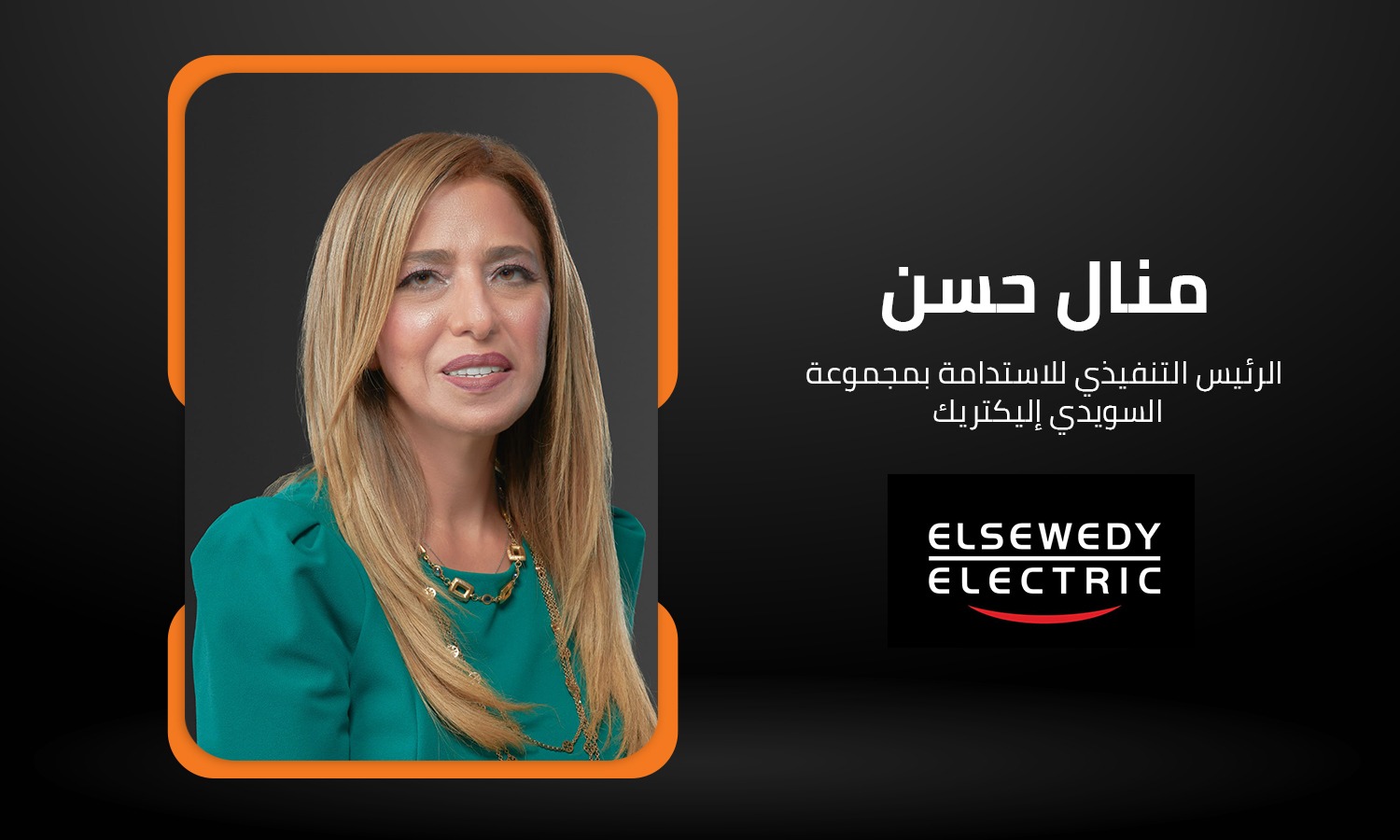
Arab Finance: Entittenance HassanCEO of sustainability in a group Swedish Electric (SWDY)One of the most prominent leaders in the Swedish Electric Group, where Hassan was distinguished by its expertise, which extends for more than 30 years in many sectors.
Hassan joined the Swedish Electric team during 2017 to occupy the position of head of the sustainability and social responsibility sector for companies, as well as the position of Vice Chairman of the Board of Trustees of the Swedish Electric Foundation.
Arab Finance met Hassan as one of the most prominent women's leaders in the field of sustainability in a series of meetings held in March, “The month of honoring women” with women influencing in their field, as Hassan took over during her career responsibility for developing the strategy of environmental and social sustainability practices and the principles of corporate governance in line with the United Nations Global Agreement initiative, and Egypt's 2030 vision.
Hassan stressed, during her dialogue with Arab Finance that the Swedish Electric Foundation focuses on developing the capabilities of society through the implementation of vital projects in the fields of health and education, and that the most important goals of the institution is to strengthen technical and professional schools, to enable them to rehabilitate skilled technicians to meet the needs of the industry, and to the text of the dialogue:
As a responsible for sustainability in the Swedish Electric Group, we talked about the most prominent projects that relied on environmental sustainability, and what is the importance of this for the company and society?
The most prominent projects that relied on environmental sustainability in the Swedish Electric Group include the development of environmental products ads, which aim to enhance transparency and accountability on the company's environmental impact.
What are the most prominent environmental risks facing the company?
Among the climatic risks we face is the introduction of new policies and legislation in the markets in which we work as it is, for example, there is a mechanism of border carbon modification, and increasing requirements related to the carbon fingerprint and the environment of products, and these risks were the basis of our plan to reduce emissions, which include measuring environmental footprint and potential gas emissions of our products, developing advertisements for environmental products that are done Check them by independent bodies, and our goal, of course, was not only measuring the fingerprint, but working to reduce the impact of our products, and for this purpose, various strategic measures have been taken to achieve this result, and include the efficiency of resource use, the adoption of renewable energy, the initiatives of the circular economy, and the insurance of raw materials from sustainable sources.
How do you see the importance of companies' social responsibility and their role in issues such as education and health?
I see that the social responsibility of companies plays a vital role in issues such as education and health, as Al -Suwaidi companies seek to enhance social prosperity and support the most needy groups in the various societies that we work with.
We choose our partners and initiatives based on the values of trust, integrity, transparency and accountability, while ensuring a fair distribution of resources. Our efforts also include assessing the impact of initiatives in the fields of education, health and development, as well as studying opportunities to contribute to achieving sustainable development goals, communicating with the concerned parties, and providing support to disadvantaged societies.
Also, Al -Suwaidi Electric Foundation focuses on developing the capabilities of society through the implementation of vital projects in the fields of health and education, and one of our most important goals is to strengthen technical and professional schools to enable them to rehabilitate skilled technicians to meet the needs of the industry.
Through investing in technical education and training, we aim to build a generation of skilled professionals who contribute to enhancing society's ability to withstand, achieving economic growth, support sustainable development, and the Foundation through these efforts seeks to meet immediate educational needs and enhance the enabling of societies in the long term, as well as supporting innovation in the industry.
What are the most prominent future projects of the company?
We have the high train project in Egypt, where Al -Suwaidi Electric Company for Power Systems Projects obtained, in an alliance with the Arab Contractors and Orascom, a contract from the National Tunnels Authority and the Ministry of Transport to implement the green line from the highway project, and the project includes the establishment of seven major stations, including the new capital, and extends a distance of 675 kilometers to link several major cities, as well as the opening of the largest factory of communications cables in Egypt where the company opened A new factory in the city of Tenth of Ramadan, the largest of its kind in the Middle East, with investments of up to two billion pounds, a production capacity of 4 million kilometers of optical fiber cables and 200 thousand kilometers of copper telecom cables.
In the field of resettling the grain silos industry in Egypt, Swedish Electric signed a cooperation protocol with a group, Bouhler Swiss and the IBC group with the aim of localizing the grain silos industry in Egypt, where this cooperation aims to enhance food security and contribute to the sustainable development of the agricultural sector.
In the field of supplying building materials, there is the supply of building materials for the Ras Al -Hikma project, where the Swedish Electric is looking to supply building materials for the Ras Al -Hikma project in the northern coast in Egypt during the next two months.
With regard to the strategy of the Swedish Electric Company for Global Executive Company, the CEO of the company, Ahmed Al -Suwaidi, announced plans to enter new markets, especially in India and Brazil, by establishing factories specialized in wires, cables, electrical products and smart infrastructure during the current year.
What are the challenges that you see stand in front of the Egyptian industry now?
The most prominent challenges facing the Egyptian industry are the high costs of production, the increase in the prices of local and imported raw materials, the high energy and electricity costs used in industrial processes, the lack of foreign currency, the difficulty of importing components and basic industries for industries due to the dollar shortage.
In terms of infrastructure and logistical support, there are challenges such as high transportation and internal and international shipping costs, as well as external competition, which relate to the flow of imported products at competitive prices, which weakens the ability of local products to compete.
In the fields of financing and investment, there are challenges facing the industry, where there is a lack of financing available to small and medium companies, which represent the backbone of the industry as well as technological challenges, especially with the dependence of many factories on old technologies, which reduces their competitiveness, and the deficiency of skilled workers trained to use modern technologies.
The Egyptian industry also faces challenges related to global economic changes such as the volatility of basic commodity prices globally and the effects of global economic changes on supply chains.
How do you see the investment opportunities available to Egypt and is the current climate of the Egyptian economy an attractive environment for investment?
Investment opportunities in Egypt are diverse and promising in many sectors, such as renewable energy that benefit from abundant natural resources in the fields of sun and wind, as well as in the infrastructure sector where the government continues to improve transportation networks, ports and new cities.
There are also great opportunities in agriculture and food industries, in addition to the growth of the technological sector and digital transformation that opens doors for investment in software and digital services, and there is the tourism sector that remains one of the main sources of investment opportunities thanks to historical and beach sites, while the financial and banking sector is witnessing a remarkable development in the fields of financial technology and digital services.
As for the economic climate, Egypt provides an attractive environment for investment thanks to government efforts to improve legislation and simplify procedures, as well as the availability of a wide base of trained young workforce, and despite some economic challenges such as currency price fluctuations and the high cost of some basic commodities, continuous improvements in the investment environment make Egypt a promising destination for investors.
What do you think of the recent tax reforms and facilities announced by the government and is it encouraging investment?
The recent tax reforms from the Egyptian government are an important step towards improving the business environment and attracting investment, as by reducing some taxes and facilitating procedures, the government provides greater opportunities for companies and investors for growth and expansion, and these facilities raise the level of confidence among local and international investors, especially in sectors such as industry and technology. The tax exemptions for large and sustainable projects encourage more investments.
How do you see the importance of including the informal sector of the official economy?
Including the informal sector of the official economy is an important step to increase economic growth and improve the business environment, which will help the government collect more tax revenues to support public projects and services, and gives small and medium -sized companies opportunities to obtain government funds and incentives. The status of workers in this sector will also improve the application of labor laws and social security in general, and this transformation enhances transparency and encourages more investments.
What is the importance of technological schools for the Egyptian industry from your point of view?
Technological schools are one of the main factors that contribute to the development of the Egyptian industry, as it focuses on training the new generation of skilled workers in the fields of technology and engineering, which meets the needs of the local industrial market by providing specialized technical education, and helps these schools in graduating specialists who are able to deal with modern technologies in various industries, which contributes to raising the efficiency of production and enhancing the competitiveness of Egyptian companies. Also, technological education contributes to reducing the gap between education outcomes and the needs of the labor market, and thus contributes to strengthening the national economy by creating new job opportunities and achieving sustainable development in the industrial sector.
What is the importance of companies ’commitment to governance and transparency?
First, good governance enhances confidence between investors, clients and partners, which contributes to attracting investments and enhancing financial stability. When the operations are clear and based on the principles of transparency, this is easy to take decisions based on accurate and correct information.
It also helps companies to governance to reduce the risks related to corruption or mismanagement, which contributes to improving general performance and raising work efficiency.
On the other hand, transparency contributes to building a strong reputation for the company in the market, which enhances its ability to expand and increase its market share, and in the end, these practices contribute to the sustainability of companies and achieve sustainable growth in the long term.
Related news

