

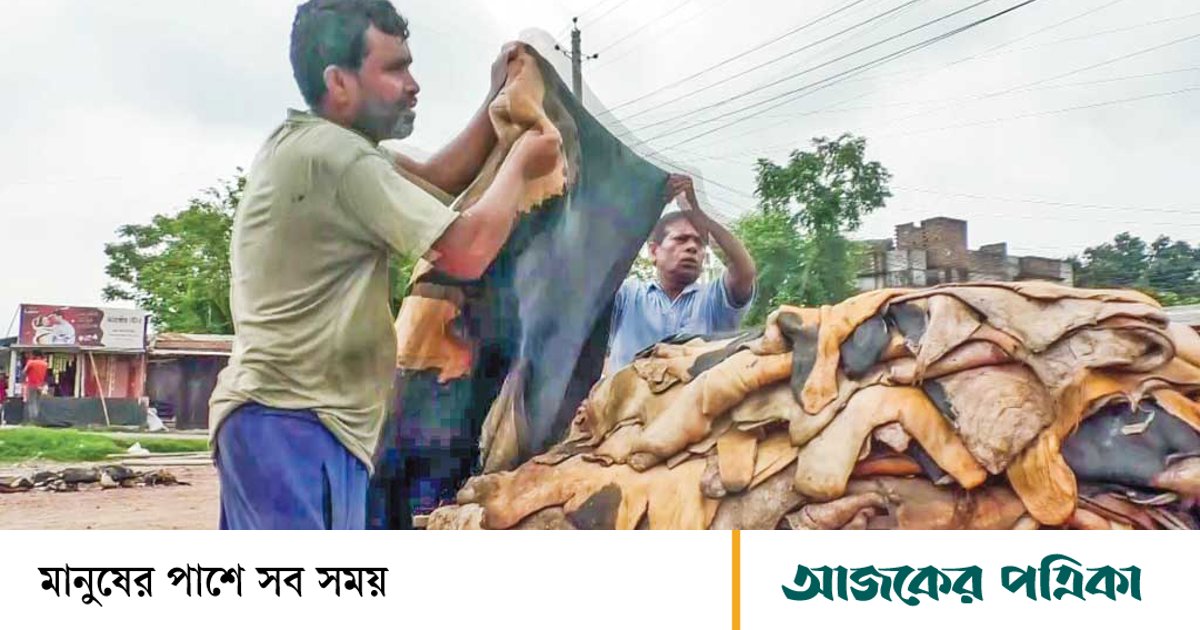
The skin of the sacrificial animal is an important national resource of the country. Large part of the tannery industry survives around this leather, earning foreign exchange, meeting domestic demand. Based on this, there is a huge employment in the sector. It is also one of the sources of income for mosque-madrasas, orphanages and lillah boardings during the season of sacrifice. But even after 55 years of independence, an integrated chain system has not been developed in the collection and subsequent management of large quantities of leather from the field. As a result, the old picture comes back when the season comes – the alarming reality of haphazard skinning, untimely application of salt, long periods left in the open and unplanned collection system. Inefficiency, lack of awareness, lack of co-ordination of traders and entrepreneurs and lack of effective monitoring in this mainly seasonal supply system lead to the same situation every year.
According to the data of the Department of Livestock, there are more than 12.3 million slaughter animals in the country, which is 2.2 million more than the demand. Concerned people fear that if proper management is not ensured in the sacrifice of such a large number of animals, a large part of the national resource leather will be at risk of being lost again.
According to the Bangladesh Tanners Association (BTA), 15-30 percent of sacrificial hides are wasted every year due to lack of proper tanning and storage. Last year also, about 30 percent of the skin was damaged due to the same reason. This reduced the price of many leathers in the international market to less than half.
The leather workers say that the crisis started immediately after the sacrifice. In almost all areas the animal is skinned by unskilled workers. Careless cutting by a sharp knife destroys the quality of the leather. The collectors then piled the hides for hours. But it is necessary to apply 8-10 kg salt to cow skin and 3-4 kg salt to goat skin within eight hours of slaughter.
But in reality in many areas the skin remains overnight. It rots. Again the seasonal traders take skins without salt to dry them. Many cannot reach on time due to traffic jams or delays. Even if one applies salt, it often does not reach the skin folds properly. As a result, decomposition starts within hours in hot and humid weather.
Posta in the capital, Tongi, Aminbazar, Rajarhat in Jessore or Atura Depot in Chittagong—almost all the big cities have the same scene every year. In some places skins lie on the open road, in others preservation is disturbed by lack of sufficient salt.
In this situation, the government has emphasized on advance preparation. Commerce Minister Khandaker Abdul Muktadir said that the government has taken it as a national responsibility to ensure that not a single skin is wasted. Before Eid, instructions have been given to highlight the importance of preserving skin in Friday sermons in the country’s mosques. Besides, initiatives have been taken to train Madrasahs, Orphanages and related persons under the supervision of City Corporation and District Administration. ‘Most hides are wasted due to improper skinning and subsequent improper storage’—a comment by Livestock Minister Mohammad Amin ur Rasheed reveals the long-standing reality of the sector. He said, learning from past bitter experiences, 22 thousand people across the country have been trained on the proper method of skinning and preservation. He hopes that if the efficiency at the field level is increased, the wastage will be reduced significantly.
On behalf of the government, salt worth about Tk 20 crore is being distributed free of cost to mosques, madrasas and orphanages. Bisik, Islamic Foundation, Directorate of Livestock and local administration are also conducting training programs in district and upazila. A special system has also been put in place to sell salt in the areas adjacent to animal markets, so that there is no crisis or artificial price increase.
Senior Vice Chairman of Bangladesh Tanners Association. Sakhawat Ullah told Ajqar newspaper that in many madrassas, the students collect skin till night, then they give salt. But they have no experience in this work. As a result, salt is not applied properly on time. Therefore, he thinks it is necessary to form a separate trained conservation team along with skin collection.

