

India and the United Arab Emirates (UAE) signed a series of agreements last Friday to further strengthen bilateral ties amid the ongoing crisis in West Asia. These include the outline of a strategic defense partnership, storage of 3 crore barrels of oil in India’s strategic petroleum reserve, supply of LPG and setting up of a ship repair cluster at Vadinar in Gujarat. Apart from this, the UAE has promised to invest a total of US$ 5 billion in India’s infrastructure sector, RBL Bank and Samman Capital.
Indian Prime Minister Narendra Modi arrived in Abu Dhabi as part of a four-nation European tour just days after the UAE came under Iranian missile and drone attacks. His short stop indicates a major development in the relations between the two countries, according to the Indian Express report.
Insisting that the Strait of Hormuz should remain ‘free, open and secure’, Indian Prime Minister Narendra Modi told UAE President Sheikh Mohammed bin Zayed Al Nahyan that India is always ‘by the side’ of the Emirates. Criticizing the attack on the Emirates, he said such targeting was ‘unintentional’.
Modi reiterated India’s support in efforts to restore peace and stability in the region. Addressing the president as ‘my brother’, he said, ‘The way the United Arab Emirates has handled the current situation with moderation is really commendable. We stand by the UAE and will continue to do so.’
Pointing out that the impact of this conflict in West Asia is being felt around the world, he said, India is ready to provide all possible assistance to restore peace in West Asia.
A statement from the Prime Minister’s Office (PMO) of India said, ‘The two leaders held several detailed discussions. During the discussion, the Prime Minister strongly condemned the attack on the UAE and expressed deep solidarity with the leadership and people of the Emirates. The Prime Minister further reiterated India’s clear position to ensure safe passage and smooth sailing through the Strait of Hormuz, which is crucial for long-term regional peace, stability as well as energy and food security.’
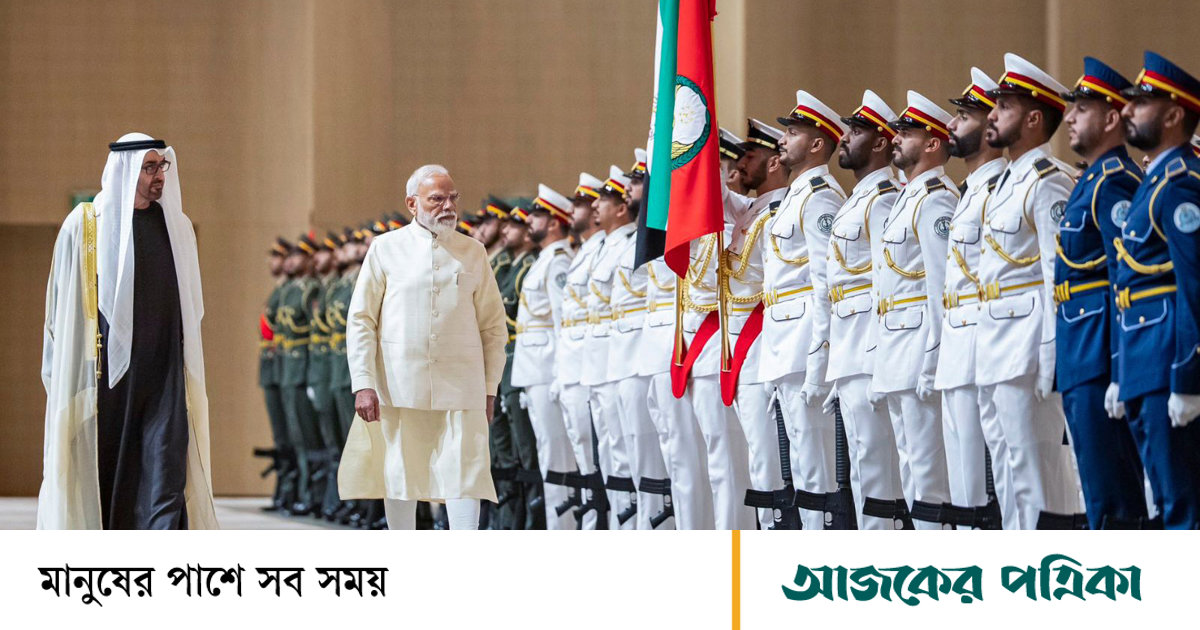
The President of the Emirates welcomed PM Modi at the airport. He was given a guard of honor there. As a special honor, his plane was escorted by Emirati Air Force fighter jets.
In a post on social media, Modi thanked the President for his “generous hospitality” in welcoming him at the Abu Dhabi airport. He also expressed gratitude for treating the Indian community living in the UAE as ‘family members’.
The President of the Emirates said, ‘The UAE and India have a long-standing strategic and economic partnership. Today, we have focused on enhancing cooperation in priority sectors including energy and technology. We are committed to the lasting progress of our countries and the maintenance of peace and stability throughout the region and the world.’
Modi visited the United Arab Emirates just a day after meeting Iran’s Foreign Minister Syed Abbas Araghchi, who was in New Delhi to attend the BRICS Foreign Ministers’ meeting.
One of the main focuses of the visit was energy security. A statement from the Prime Minister’s Office said, ‘Both leaders appreciated the growing and vibrant energy partnership between the two countries. UAE continues to play an important role in India’s energy security in terms of supply of crude oil, LNG and LPG. Leaders agreed on new initiatives for an integrated energy partnership. In this context, they welcomed the conclusion of a strategic cooperation agreement between Indian Strategic Petroleum Reserves Limited and Abu Dhabi National Oil Company. This will increase the UAE’s participation in India’s strategic petroleum reserves to 30 million barrels and they will work together to develop strategic gas reserves in India.’
Apart from this, they also welcomed the long-term LPG supply agreement between Indian Oil Limited (IOCL) and Abu Dhabi National Oil Company (ADNOC).
The fourth largest source of India’s crude oil last year was the United Arab Emirates, which met about 11 percent of India’s total demand. Besides, the emirate is India’s largest source of LPG, supplying nearly 40 percent of the country’s demand.
UAE is the first country to partner with India’s strategic petroleum reserves. In 2018, ISPRL and Ednoc entered into an agreement under which ISPRL’s facility in Mangalore will store over 5 million barrels of UAE crude oil.
ISPRL is a specialized government agency under the Ministry of Petroleum and Natural Gas of India, responsible for maintaining the country’s strategic crude oil reserves. It stores 5.33 MMT (million tonnes) of crude oil in three underground facilities to ensure fuel security in case of supply disruptions.
The UAE’s $5 billion investment will have three main components: Abu Dhabi Investment Authority (ADIA) and India’s National Infrastructure and Investment Fund (NIIF) will jointly seek investment opportunities of up to $1 billion in India’s infrastructure sector; Emirates New Development Bank (ENDB) to invest $3 billion in India’s RBL Bank; And International Holding Company will invest $1 billion in India’s Samman Capital.
The Prime Minister’s Office statement further said, ‘These investments are an expression of the UAE’s consistent and long-term commitment to India’s growth story and will further strengthen the bilateral strategic investment partnership.’
Regarding the defense agreement, it said the leaders of the two countries recognized bilateral defense cooperation as an important pillar of their overall strategic partnership.
During the visit, they welcomed the signing of the ‘Strategic Defense Partnership Framework’ between the two countries. Under this, the two sides agreed to deepen cooperation in defense industry and innovation and advanced technology, training, joint exercises, maritime security, cyber defense, secure communication and information sharing, Prime Minister Narendra Modi’s office said.

