

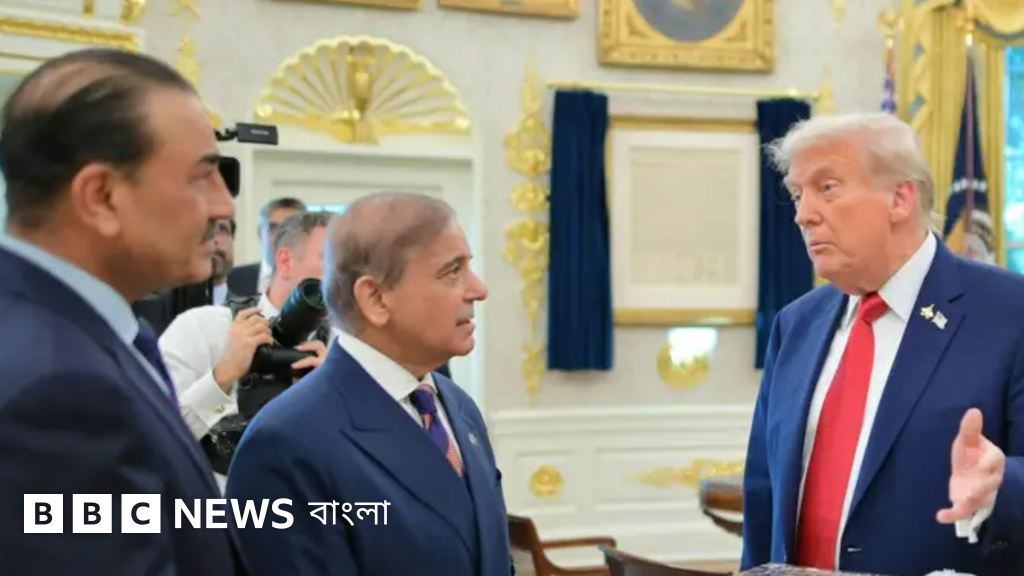
image source, Pakistan PMO
After long efforts, the US and Iran have finally agreed to a two-week ceasefire. This is expected to end the Iran war that has been going on for more than a month.
US President Donald Trump has set a deadline for Iran to open the Strait of Hormuz and sign an agreement with the US.
He threatened to launch a major attack on Iran if the Strait of Hormuz was not opened by 8:00 p.m. on April 7, North American time.
“An entire civilization will be destroyed tonight, never to return. I don’t want it to happen, but it probably will,” Trump wrote on the social media site Truth Social on Tuesday evening.
After his threat, widespread anxiety and worry spread among Iranians. It is known that they stayed up all night on Tuesday for fear of attack.
Shortly before the end of the ultimatum, Pakistan’s Prime Minister Shahbaz Sharif said that both Iran and the United States had agreed to a ceasefire.
“I very humbly announce that the Islamic Republic of Iran and the United States and their allies have agreed to a ceasefire everywhere, including in Lebanon, effective immediately,” said Mr. Sharif.
UN Secretary General Antonio Guterres welcomed the ceasefire decision.
He urged both sides to abide by the terms of ceasefire and international law to pave the way for permanent peace in the Middle East.
After agreeing to a cease-fire, both the US and Iran declared themselves victorious. Israel also supported Trump’s decision.
The ten conditions offered by Iran to stop the war have been presented to the US. On the other hand, Trump last month called on Iran’s rulers to accept 15 conditions.
But in the end exactly what terms did they agree to a truce?

image source, Anadolu via Getty Images
Iran’s ten conditions
US President Donald Trump said that Pakistan Prime Minister Shahbaz Sharif presented 10 conditions to Iran before announcing a ceasefire.
“We made this decision based on a request from the government of Pakistan and a ten-point proposal from Iran. We believe this proposal can be a useful basis for negotiations,” Trump wrote on social media site Truth Social.
10 conditions have been highlighted in Iran’s official media.
They include:
* Ensuring that Iran and its allies will not be attacked again.
* Continued Iranian control of the Strait of Hormuz.
* Not obstructing Iran’s nuclear enrichment program.
* Removal of all direct and indirect sanctions on Iran and immediate return of all Iranian assets and properties held abroad.
* Repeal all UN Security Council resolutions against Iran.
* Abolition of International Atomic Energy Agency proposals.
* Reparations to Iran.
* Withdrawal of US troops from the Middle East.
* Enforce ceasefire on all fronts including Lebanon.
Iranian media claimed that the United States had accepted these terms. However, the United States has not confirmed it.
However, the BBC has confirmed that both sides have agreed to open the Strait of Hormuz.
Also, Tehran has pledged not to build nuclear weapons even if it enriches uranium.
The U.S. president said that Iran’s nuclear enrichment so far will be “adequately managed.”
“I wouldn’t have settled otherwise,” Trump told AFP after the ceasefire was announced.
However, he did not give any specific information about what kind of measures are being taken regarding Iran’s uranium.
Trump has learned that China also played a role in persuading Iran for a ceasefire.

image source, Reuters
What is in Trump’s plan?
In late March, Donald Trump sent a 15-point peace plan through Pakistan, urging Iran’s rulers to accept them.
However, Iran rejected it at the time. But the White House released a statement from the Iranian government after the cease-fire was announced.
In addition to Iran’s ten-point peace proposal, President Trump’s 15-point peace plan is also mentioned.
Trump’s plan has not been disclosed.
However, it is understood that it included control of Iran’s ballistic missile and nuclear programs as well as keeping the Strait of Hormuz open.
Iran’s leaders dismissed Trump’s claims as ‘exaggeration’.
According to Iranian state media, Tehran later sent a ten-point proposal aimed at a “permanent end” to the war in response to Trump’s terms.
In a social media post, the US president said the terms would be discussed further between the two sides.
Meanwhile, Israel has officially released a statement on the cease-fire with Iran.
Israel supports US President Trump’s decision to suspend attacks on Iran on the condition that it immediately opens the Strait of Hormuz and stops all attacks on Israel and US military infrastructure.
Israel said in a statement that Donald Trump is working to ensure that Iran “does not pose any more nuclear, missile and terrorist threats” to Israel, the United States and its allies in the Middle East.
As a result, it is believed that these issues may be included in Trump’s peace plan.

image source, Getty Images
‘Islamism Talk’
Pakistan has called a meeting between Iran and the US in Islamabad on April 10 for ‘further discussions to reach a final agreement to settle the dispute’.
Shahbaz Sharif invited the delegations of both sides to participate there.
He hopes that ‘peace and stability’ will return to the Middle East through that meeting.
“We sincerely hope that the ‘Islamabad Talks’ will succeed in achieving lasting peace and look forward to more good news in the coming days,” said Pakistan’s Prime Minister Shahbaz Sharif.
However, it is not yet clear how successful the talks will ultimately be.
Analysts say that in the past, such discussions have been held between various parties, but due to lack of consensus, it has finally turned into military tension.
What can happen between Iran and the United States?
“You’ll see that (ahead),” Donald Trump told AFP when asked if Iran would attack the United States again if the talks break down.
Also, while announcing the ceasefire, Pakistani Prime Minister Shahbaz Sharif said, “The Islamic Republic of Iran and the United States and their allies have agreed to a ceasefire everywhere, including Lebanon.”
But Israel says that even if it accepts a cease-fire in Iran, it will not apply to Lebanon.
As a result, there are doubts about the extent to which the expectation of permanent peace in the Middle East will be fulfilled through the Islamabad meeting.
https://www.bbc.com/bengali/articles/cn8dxzl1lx0o?at_medium=RSS&at_campaign=rss

