

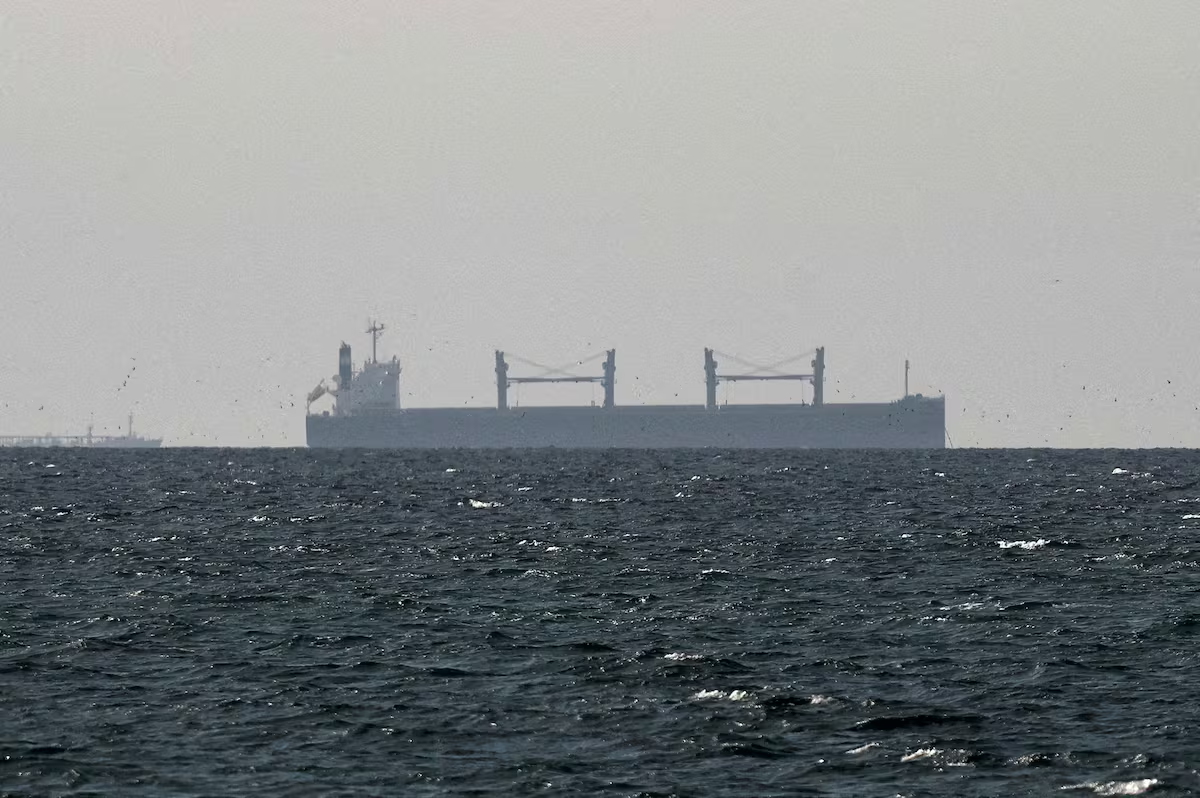
Just an hour and a half before Donald Trump’s ultimatum expired, The United States and Iran have agreed to a 15-day ceasefire to advance the negotiations for a definitive agreement to end the conflict that began on February 28 and that has shaken the entire Middle East. During that period, the Iranian regime will allow free transit through the Strait of Hormuz and the United States and Israel will refrain from attacking targets in Iran. These are the main keys to the pact.
What has been agreed?
Washington and Tehran have agreed to establish a two-week ceasefire. The agreement was confirmed on Tuesday night, just an hour and a half before the conclusion of the ultimatum set by US President Donald Trump for Iran to agree to reopen the Strait of Hormuz or face death. “of an entire civilization”.
The war, which was already entering its sixth week, has cost the lives of more than 5,000 people in a dozen countries in the region, with Iran and Lebanon accounting for the highest number of deaths.
During these two weeks, Iran will allow maritime traffic through the Strait of Hormuzwhile the United States pledges not to attack targets in Iran. Hours later, Israel announced that it was adhering to the agreement with Iran, but stated that the cessation of hostilities does not include Lebanon and that it will maintain its offensive against Hezbollah. In fact, this Wednesday, it continued attacking militia targets in southern Lebanon and the capital, Beirut. attacks that have resulted in the deaths of dozens of people.
If reached, the final agreement will come after these next 15 days.
How was this agreement reached?
Pakistan has emerged as the key intermediary to achieve this ceasefire. It was the Iranian president, Masud Pezeshkián, who has expressed “acceptance of the general principles” of the United States regarding the points presented by Iran. Trump has declared “belief” that China managed to get Iran to negotiate this cessation of hostilities.
What will happen next?
The United States and Iran will sit at the negotiating table. The dialogue, as announced by Pakistan and later confirmed by Iran, will start this friday in the Pakistani capital, Islamabad. The ultimate intention: “Reach an agreement that resolves all disputes.”
White House spokesperson Karoline Leavitt has acknowledged that the possibility of in-person conversations is being discussed, but has clarified that “Nothing is final until it is announced by the president or the White House”.
What will be the basis of the negotiation?
Initially, both parties assured that Iran’s 10-point plan would be the basis of negotiations. However, this Wednesday morning, Donald Trump assured that the negotiation will be carried out on the 15 points he presented two weeks ago.
What did the original US-Israeli proposal include?
Although the text of the 15 points proposed by the United States and Israel has not yet been published in its entirety, several of the requirements are known. Among them, a 30-day ceasefire, the reopening of the Strait of Hormuzthe dismantling of Iranian nuclear power plants, the delivery of enriched uranium to the International Atomic Energy Agency (IAEA) and a commitment not to develop atomic weapons. It also requires Iran to limit the number and range of its missiles, as well as stop attacking the region’s many energy infrastructures. Finally, it demands the cessation of Iranian protection for proxys like Hezbollah.
This proposal, presented on March 25, was rejected by Iran, which called it “excessive”.
What does the Iranian proposal include?
The roadmap that Tehran presented on Monday includes a non-aggression pact between both parties, that Iran continue to control the Strait of Hormuz – where a cost of two million dollars per ship that crosses there -, the lifting of several “primary” and “secondary” sanctions, as well as the elimination of the resolutions of the UN Security Council and those of the IAEA board of governors against the country.
Iran has also demanded compensation for the damages suffered, although it is not entirely clear if it will be done through US payments or if it will be satisfied by extra charges to ships that cross Hormuz.
Tehran assures, in the Farsi version of the agreement, that Washington accepts that the Islamic Republic can continue “enriching (uranium)”, the main reason that led the United States and Israel to attack in the first place. It is also not clear which one it refers to: for energy or military purposes. For now, through a publication on his social network, Truth, US President Donald Trump has stated that “there will be no uranium enrichment.”
Finally, Iran has demanded the withdrawal of US troops from the region and the cessation of the war on all fronts, including in Lebanon. This point also includes Israel, which has agreed to “stop attacking” Iran. However, Israeli Prime Minister Benjamin Netanyahu has clarified that “this does not include Lebanon”.
The consequences
The basis of this two-week ceasefire is for Iran to reopen Hormuz to naval traffic, but analysts have already indicated that it will still take time for confidence to be restored in this strategic crossing, through which 20% of the world’s oil circulates.
Immediately after the announcement, the price of oil a drop of nearly 15% began and a barrel of crude oil sank below $100. In the case of gas, the falls have also reached 20%.
https://elpais.com/internacional/2026-04-08/claves-del-acuerdo-de-alto-el-fuego-entre-iran-y-estados-unidos.html

