

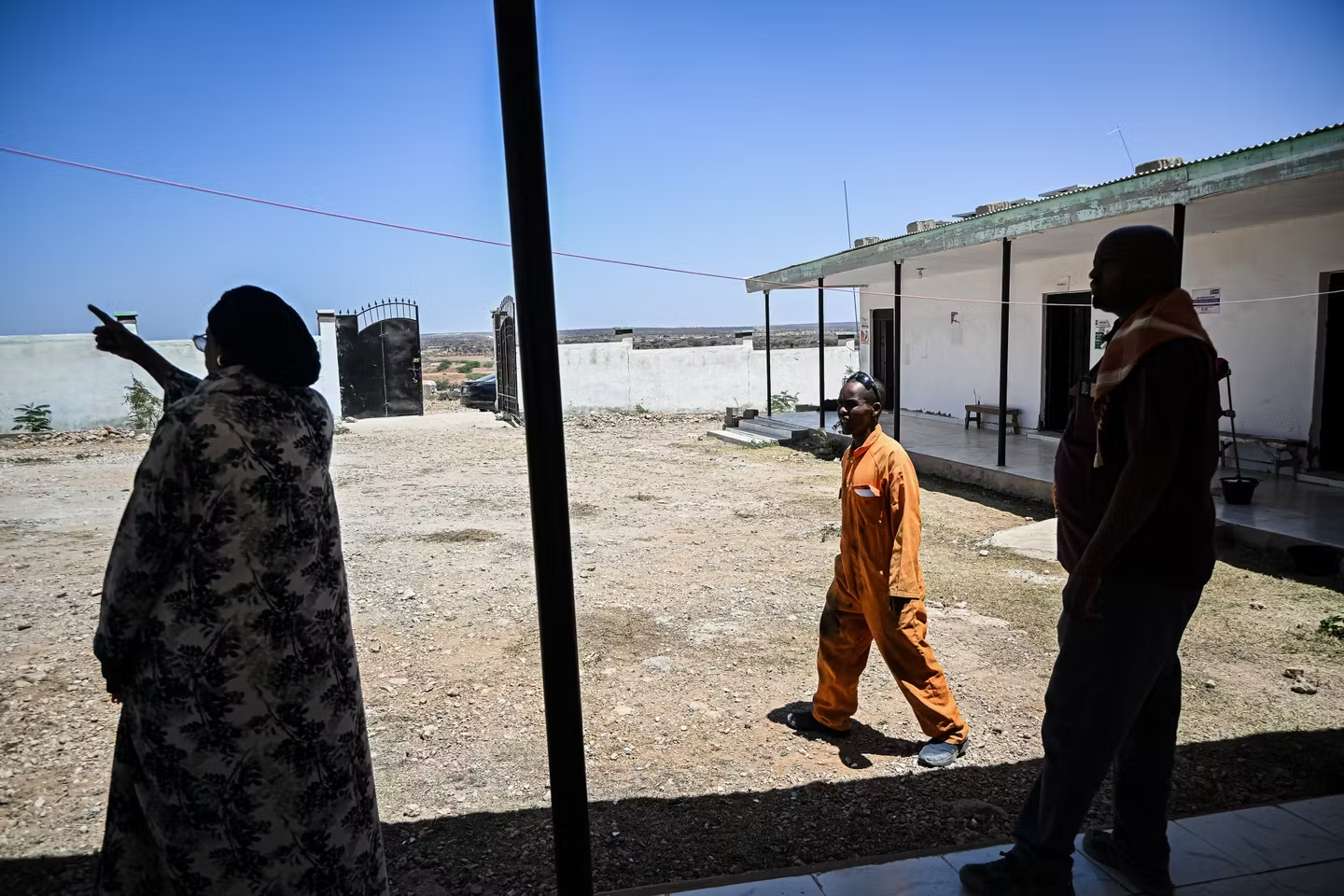

The Habaas Weyn health center sits on a hill lost in the middle of the arid vastness. From the top of this modest health center located 40 kilometers from the Somaliland capital, Hargeisa, you can see nothing other than the asphalt road below and a few acacia trees. Neither houses nor herds. The “great dust” (« Big Haas »in the Somali language) is the reference structure for a catchment area of 8,000 people: semi-nomadic herders, dispersed in the bush.
This three-year-old rural health center was created to reach out to the country’s most vulnerable populations. Somalia and the self-proclaimed republic of Somaliland are lagging far behind: they have the second highest infant mortality rate in the world, after Niger: 106 children out of 1,000 die before the age of 5, according to Unicef figures in 2023.
In the remote countryside of the territory, “Women give birth at home rather than in health centers like ours”notes Nimco Abdi, 30, one of the two midwives at the Habaas Weyn health center. “They have no car, no money to pay a truck driver who could drive them. Above all, they fear not having the means to pay for postpartum care.she explains, her two wrists surrounded by beaded bracelets in the colors of Somaliland – green, white and red –, a symbol of local pride.
Hinda Mohamed practiced these makeshift deliveries for twenty-five years. Originally from this region of Marodi Jeh, she served as a traditional midwife for a quarter of a century, a « charge » informal transmitted by his mother. The role consists of traveling through the countryside to support home births: “I have seen many stillbirths and infants with fatal anemia. » The procedures, she says, are sometimes performed without a basin of water and most often without soap, increasing the risk of infections.
Mother of the Nation
“Hemorrhaging cases were the most common, I had nothing on hand. So we had to manage to get them to Hargeisa urgently. Already, at the time, I kept telling women that they had to go to clinics if they wanted to save their baby”she assures.
It is also as much a question of the health of newborns as of that of mothers: Somalia is the fifth country with the highest maternal mortality rate, according to the World Health Organization (2023) – the UN does not differentiate between Somalia and this autonomous territory.
The Habaas Weyn health center is the work of the woman who embodies both the struggle of women and the progress of health in Somaliland. At 89 years old, Edna Adan likes to repeat it: she had a “full existence”. Multiple lives, we should say, to summarize the trajectory of the woman who was both the country’s first midwife and its first minister of foreign affairs (2003-2006), all after studies in the United Kingdom and a career as a diplomat at the United Nations and who, by way of retirement, set up a hospital and a medical school in the heart of Hargeisa.
This mother of the nation reveals herself to be as inexhaustible on the situation of women as on the political future of her country, including sovereignty was first recognized in December 2025 by Israel. Her hospital in Hargeisa, where she lives, has recorded only one death in the past three years.
Nothing to be happy about, she warns, because “this assessment contrasts with reality in rural areas where infections but especially infibulations (narrowing of the vulva by means of suture) kill women and children ».
For Edna Adan, the fight against excision and against infant mortality go hand in hand because genital mutilation, still practiced on 99% of Somaliland women, leads to complications during childbirth. The old midwife has been waging this fight for five decades and is beginning to see meager results.
“Good practices will ultimately pay off”
“The number of excisions has not changed today, it is the type of mutilation that is evolving, observe-t-elle. We see it on the operating table. » A fatwa launched by a minister in 2018 condemned type 3 excision, known as infibulation. Type 1 excision, known as « sunna » (partial removal of the clitoris), is tolerated in Somaliland – no law criminalizes this practice.
This doctor’s daughter, who doesn’t keep her tongue in her pocket, also knows how to roll up her sleeves. The octogenarian with boundless energy recounts how, a few years ago, she went into the bush to save a baby whose umbilical cord was bleeding dangerously.
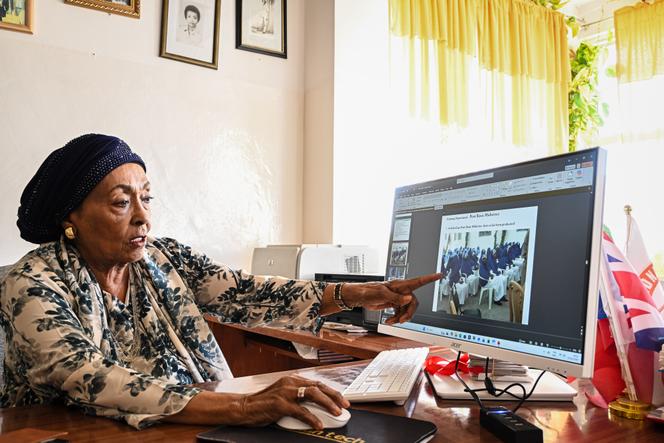
She inherited this unfailing mentality, according to her, from the difficult birth of her country, Somaliland, in 1991, “when Hargeisa was a ghost town, destroyed by bombs and whose ground was littered with anti-personnel mines”. In 1988, the Somaliland capital was almost razed to the ground by the air force of Somali leader Mohamed Siad Barre, during the civil war between the Mogadishu regime and the Somali National Movement rebels.. Everything had to be rebuilt without foreign assistance.
Thirty-five years later, she regrets the lack of public health resources mobilized by the United Nations, “too focused on the government in Mogadishu”. “At the time, we only had 13 doctors in Somaliland”she likes to point out to better illustrate that the territory did not wait for international aid to develop. Will it be the same to fight against infant and maternal mortality? “Today, we have female surgeons and midwives who, everywhere, in the four corners of the country, spread good practices. It will pay off in the end,” she emphasizes.
https://www.lemonde.fr/afrique/article/2026/04/08/le-combat-solitaire-du-somaliland-face-a-la-mortalite-maternelle-et-infantile_6678287_3212.html

