

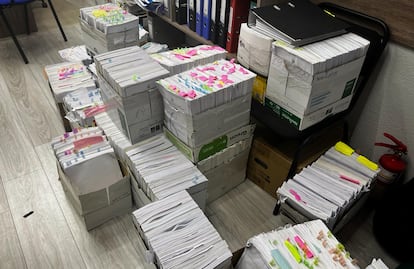
Boxes and cardboard boxes with hundreds of accumulated files occupy the floor of a room in a building in kyiv. They correspond to cases of possible war crimes committed by the Russians during the great invasion of Ukraine unleashed from February 2022. These ramshackle facilities, several stories high, could easily be the setting for a thriller. Behind the door of another room, a surprisingly small but renovated and well-lit office is surprising. A large map of the surroundings of the Ukrainian capital, full of markings and directions, hangs on the wall. Around the table, there are two men, Artur and Dmytro (the latter is not his real name), and a woman, Alla. They are police officers dedicated body and soul during these four years to trying to unravel all these cases. “We have 3,000 files for eight agents,” they complain. Referring to the shortage of troops in the army, they imply that this is another front in which they are in great need of help.
In the fifth year of the great Russian invasion, the investigations are advancing like a dinosaur and in the midst of a great lack of material and human resources, according to some specialists. The Prosecutor’s Office raises possible war crimes to more than 216,000 and there are 253,000 victims identified, according to data from February. “We do not have the physical capacity to investigate all this number of crimes,” as it is something “unprecedented,” estimates Maryna Slobodianiuk, a researcher at Truth Hunds, one of the humanitarian organizations that collaborates to shed light and denounce what is happening. He estimates that the number of cases is around one hundred per researcher, something “unaffordable.”
At the end of September 2025, when the estimate was still 185,000 cases, only 446 had reached the courts and 156 had been sentenced, that is, less than one in every thousand, according to a study carried out by the Ukrainian Union for Human Rights in Helsinki. The report also focuses on the impossibility of the system when it comes to managing such magnitude of crimes. They cover extrajudicial executions, bombings and attacks on civilian infrastructure, deportation of minors, torture, sexual violence or forced disappearances.
“67.2% of prosecutors – 64 have been interviewed – provide procedural guidance in more than 100 war crimes cases at the same time, the same figure given by Slobodianiuk. For comparison: only 27.4% of investigators – 117 have been interviewed – have more than 100 cases in progress. Such disproportion inevitably affects the quality of the processes and generates risks for compliance with procedural rules,” warns the text, published at the end of February.
Likewise, a lack of technical means has been detected: vehicles with and without armor, spaces where work can be carried out, office equipment or personal protection. Those responsible must carry out their task “often under fire” and “missiles.” In fact, access to evidence is often limited because it is on the front lines or in Ukrainian territory under Russian occupation.
The authors call for improvements from the Government, Parliament and the Prosecutor’s Office of Ukraine, aware that it is a great challenge to achieve this in the middle of the conflict, which “poses additional challenges” to undertake “an effective investigation of war crimes for the future of justice and national memory.” In any case, “guaranteeing justice for more than a quarter of a million victims requires (…) a structural transformation of the police system,” they add.
“First of all, we need people, we need someone to carry out the work and, of course, we need a lot of technical equipment,” adds Maryna Slobodianiuk, who has investigated crimes in different regions of Ukraine for Truth Hounds, an organization born in 2014, when Russia launched the invasion of eastern Ukraine and Crimea. The most complicated case he has faced has been the attack with an Iskander missile on the Ria Pizza restaurant in Kramatorsk in the summer of 2023, in which a dozen people were killed, including the writer Victoria Amelina.
The Prosecutor’s Office tries to gather as much information as possible, even from those who have left the country during the conflict. “We ask everyone who witnessed a war crime to inform the law enforcement agencies of the country where they are now,” requests a message on its website. Since 2022, 1,127 suspects have been identified; There are 809 accused and 242 convicted, according to data from the Prosecutor’s Office made public in the Suspilne media on March 4. Among the suspects are 30 prisoners of war. Of them, 27 have been charged and their cases brought to court, while 22 have already been sentenced.
“The easiest cases to investigate” are those “in which Ukrainian investigators have access to suspects, that is, cases related to crimes committed by Russian prisoners of war,” says Kostiantyn Zadoya, professor at the Department of Politics and Criminal Law at Taras Shevchenko National University and specialist at the Center for Civil Liberties (CLC) of Ukraine, which published the study prepared by the Ukrainian Union for Human Rights in Helsinki. The CLC was awarded the Nobel Peace Prize in 2022 for his fight for human rights. “However, these are very few. Most procedures are carried out in absentia, which immediately complicates the investigation process, regardless of what type of war crime it is,” adds Zadoya.
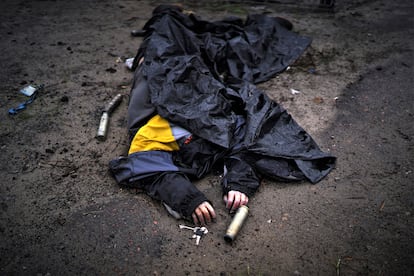
Such is the case, for example, of the three Russian soldiers who participated in the occupation of Bucha, on the outskirts of kyiv, in 2022, accused by the Ukrainian authorities of murder of engineer Sergey Emelyanov March 8 of that year. The three are identified, but out of the reach of justice for the moment. The investigation has been carried out precisely by the three agents who received the special envoy of EL PAÍS in their office.
In the midst of the enormous mountain of pending cases, Zadoya sees it very unlikely that the highest Russian officials responsible for the invasion of Ukraine, such as President Vladimir Putin, will sit in the dock. “That would be realistic if investigators from the International Criminal Court (ICC) or Ukraine were able to access these people. However, this could only happen if there is a radical change in the situation in Russia. And it is difficult to predict when such changes could occur,” assesses the law professor.
This Court, based in The Hague (Netherlands), issued an arrest warrant against the Russian president for war crimes in March 2023 for his possible relationship with the deportation of children. But Moscow does not recognize the TPI, which limited itself to requesting the collaboration of the international community in case he could be arrested during any of his movements. Putin is the third sitting president to have received an arrest warrant from this court, after Omar al Bashir of Sudan, and Muammar Gaddafifrom Libya.
A UN investigation concluded on March 10 that the deportation and transfer of Ukrainian children by Russian authorities constitute crimes against humanity. After following 1,205 cases of children from five Ukrainian regions, it has been concluded that 80% of them have not yet returned to Ukraine. Ukrainian authorities claim that Russia has illegally deported or forcibly displaced more than 19,500 children towards Russia and Belarus, in violation of the Geneva Conventions.
In January last year, Ukraine became the 125th member country of the International Criminal Court. Has that meant any change? “Nothing, in general,” says Professor Zadoya.
Agents Artur, Dmytro and Alla allow us to photograph the room where the boxes with the files are crowded. They observe the panorama with a half smile, aware that they have a very difficult wall to overcome before them. Dmytro tries to give an idea of how the invasion orchestrated by Putin has changed their lives even on a personal level. In his case, he separated from his wife, who has a pro-Russian stance, since Moscow attacked Crimea and part of the regions of Donetsk and Lugansk, where she now lives, in 2014. He tells it as very old water, as if it were part of another war.
https://elpais.com/internacional/2026-03-26/ocho-policias-para-3000-casos-el-reto-de-investigar-los-crimenes-de-guerra-en-ucrania.html

