

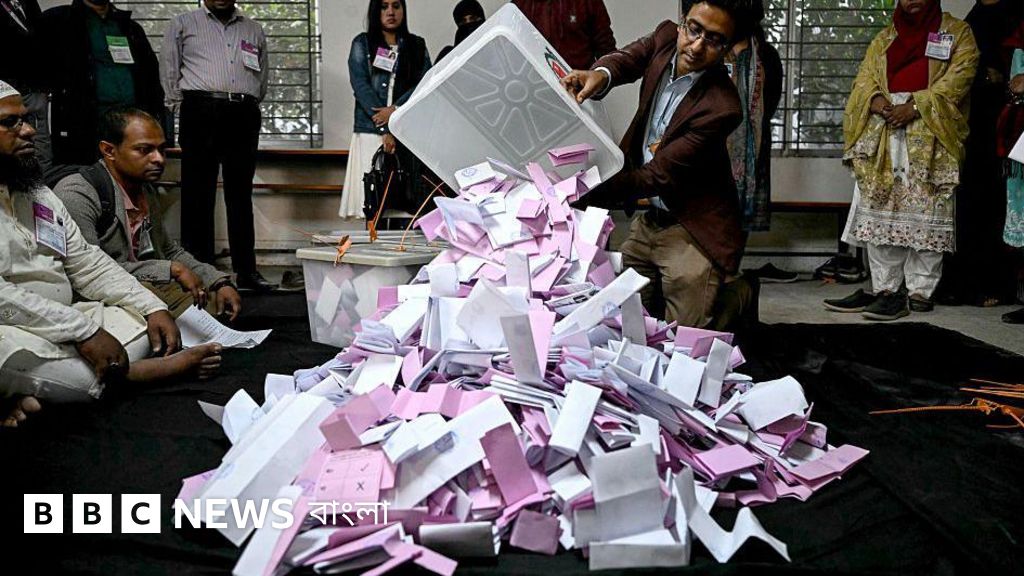
image source, Getty Images
Transparency International Bangladesh (TIB), an international anti-corruption organization, said that multiple irregularities were seen in at least 40 percent of seats in the 13th National Assembly elections.
TIB released a report on this on Monday afternoon.
In the report entitled ‘Thirteenth National Assembly Election Process and Affidavit Based Monitoring’, it is said that the TIB observed irregularities in 70 constituencies based on random selection.
In other words, the 40 percent of the seats that are talking about irregularities are not 40 percent of the total 300 seats, but 40 percent of the 70 seats.
However, in the question and answer session, TIB’s Executive Director Dr. Iftekharuzzaman.
According to the report, although the Awami League did not participate in the election, ‘the fact that it was fair, impartial, inclusive and participatory election was acceptable.’
TIB found irregularities in seventy seats?
Among the irregularities that TIB found in 70 constituencies, the most common irregularities were threats to drive voters away or not allowing them to enter the polls.
TIB says such complaints were found in 46.4 percent of the 70 constituencies it monitored.

image source, Getty Images
Other irregularities reported in the poll monitoring of 70 constituencies:
- Voters were forced to vote on ‘fixed marks’ in 35.7 per cent seats.
- Fake votes were cast in 21.4 percent seats.
- Booth encroachment occurred in 14.3 percent seats
- 14.3 percent did not allow opposition polling agents to enter the center
- The same rate of sealing of ballots before polling took place i.e. 14.3 percent of the constituencies.
- Biased activities of election officials including returning officers were found in 10.3 percent constituencies.
- Incidents of obstructing journalists at polling stations are in 7.1 percent of the constituencies
- Allegations of vote counting fraud in 7.1 percent seats.
In an overall observation, TIB said, “Despite the initial signs of relatively healthy competition, the political parties and candidates have gradually maintained the old political practices of the electoral process.”
“As a result, intra-party infighting between parties and coalitions in the elections, unhealthy competition for power and violence escalated, which continued in the post-election period.”
Has the election been engineered?
Despite the occurrence of various irregularities, TIB’s Executive Director Dr. Iftekharuzzaman.
He said, “In our view, we did not get any engineering. The election was relatively fair, acceptable and competitive.”

However, in the report, it is commented that there have been allegations of election engineering from the opposition political parties.
In this case, the allegation of up to 10 percent rigging, including “irregularities in vote counting” by the eleven party alliance, is mentioned.
It is said that the alliance has demanded recount of votes in 32 constituencies.
Is the election participatory?
Awami League did not participate in this election. As a result, questions are asked in the question and answer session whether the election is participatory.
In response, the executive director of TIB. Iftekharuzzaman said that the election was participatory.
As the reason, he said that many people of Awami League voted.
“At many places at the grass root level, Awami League leaders and workers chanted Jai Bangla slogans and asked them to vote with rice grains or scales. They voted. There is no way to say that hundred percent of Awami League leaders and workers did not vote.”
Mr. Zaman said that although Awami League announced to resist the election, “their workers-supporters participated in the election as voters”.
Although ‘a section of the party abstained from voting’ – that also applies to the general electorate.
“The fact here is that it has been an acceptably fair, impartial, inclusive and participatory election.”
https://www.bbc.com/bengali/articles/c5ygen59j15o?at_medium=RSS&at_campaign=rss

