

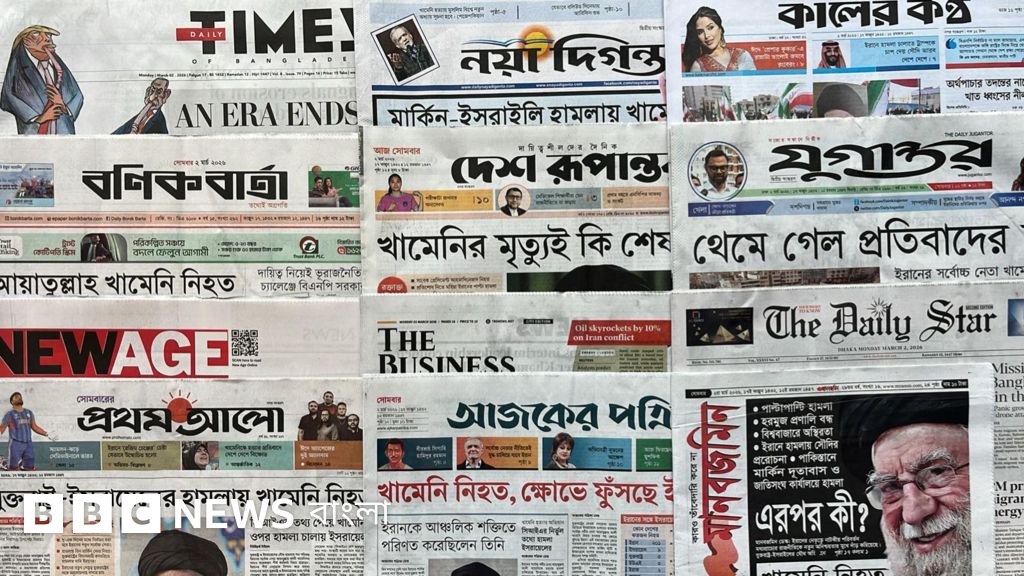
Reading time: 6 minutes
Unsettled situation prevails across the Middle East in the wake of US and Israeli military strikes on Iran. In such a situation, Middle Eastern countries have closed their air borders.
As a result, airlines operating flights from Bangladesh to Middle East countries like other countries of the world have stopped operating flights due to security reasons.
From the afternoon of February 28, Iran, Iraq, Kuwait, United Arab Emirates, Bahrain, Qatar and Jordan declared their airspace temporarily closed. This has a direct impact on Dhaka’s Hazrat Shahjalal International Airport.
Therefore, a total of 74 flights of different airlines have been canceled in three days. Thousands of passengers bound for the Middle East have suffered due to flight cancellations.

News from English daily The Daily Star- 17 killed at pro-Iran protests in Pakistan In other words, 17 people were killed in protests in support of Iran in Pakistan.
At least 17 people have been killed in protests in Pakistan over the death of Iran’s supreme leader.
Protesters in various cities clashed with police as they tried to enter the US embassy and consulate in the streets.
At least 10 people were killed and more than 70 injured in the clashes in Karachi.
Seven people were killed in clashes with police in the northern city of Gilgit.
Thousands of people took part in the protest in the capital Islamabad. Police used tear gas to control the situation.

image source, AP
Bangladesh has expressed deep concern over the conflict spreading in the Middle East after the recent attack on Iran.
The statement issued by the Ministry of Foreign Affairs called on all parties to show restraint and abandon the military path and return to diplomatic talks.
The statement said, this unrest is not only threatening regional peace but also the lives and security of common people.
Violations of the sovereignty of various countries including Bahrain, Iraq, Jordan, Kuwait, Qatar, Saudi Arabia and the United Arab Emirates have also been condemned.
Meanwhile, the new government that came to power, the Bangladesh Nationalist Party (BNP), is caught in the middle of a weak economy and an energy crisis.
The war situation has become a major challenge for the government due to its dependence on the Middle East for energy and expatriate income.

Ayatollah Ali Khamenei was the supreme leader of Iran for more than three decades. During this long period, he made Iran one of the regional powers.
Throughout his tenure, he was a strong critic of the policies of the West, including the United States and Israel. At this time, he suppressed the opposition to retain power. The 86-year-old leader was killed last Saturday in an attack by Israel and the United States.
According to The New York Times, US President Donald Trump announced Khamenei’s death on social media.
He writes, Khamenei, one of the most feared people in history, has died. Later, Iran’s state media confirmed the news.
Seyyed Ali Hosseini Khamenei began ruling the country based on staunch Islamist and anti-Western ideals.
During his rule, any attempt at reform was suppressed with a heavy hand, calling it a Western conspiracy.

News of country transformation newspaper- Iran in power change. After the death of Supreme Leader Ayatollah Ali Khamenei, Iran is in the process of transition of power.
A high-level committee has been constituted to oversee the transfer of power during this interim period.
The council includes Iran’s president, the head of the judiciary and a faqih (jurist) from the influential Guardian Council, the country’s state news agency IRNA reported.
This council of three members will temporarily take charge of all the leadership and state activities of the country. After the news of the death of Iran’s supreme leader Khamenei was confirmed, the question arose – who will lead Iran in this critical time.
Iran’s constitution provides specific procedures for the death of the Supreme Leader. In that process, a council of three members including the president has been given the responsibility of running the country.
In Iran’s political system, several authorities or organizations work for decision-making.

On Sunday, the air and air of Tehran was shaken by the sudden explosion of the bomb.
It was reported that former President Mahmoud Ahmadinejad and the head of the intelligence police were killed in this attack.
In addition, at least 133 people lost their lives in this attack in Iran.
Meanwhile, even after the death of supreme leader Khamenei, Iran continues to fight without collapsing.
The Islamic Revolutionary Guard Corps (IRGC) has attacked 27 US bases in response to their allies, including the United States and Israel.
At least 200 US soldiers are claimed to have been killed in these attacks.

After the attack by the US and Israel, a ship’s radio message on Saturday night warned of the cessation of shipping through the Strait of Hormuz.
Since then, there has been uncertainty in the Middle East-dependent import-export trade.
However, Iran’s Foreign Minister Abbas Aragchi told Al-Jazeera on Sunday that they have no plans to close the Strait of Hormuz.
Traders and people related to the energy sector say that even if the Strait of Hormuz is closed, there is no immediate danger of an energy crisis. If the situation is prolonged, the supply system may become strained.
Bangladesh products are brought and taken with Iraq, Iran, Qatar, Kuwait, Bahrain, United Arab Emirates and Saudi Arabia using Strait of Hormuz.
Due to the war situation, transportation risks have also arisen from neighboring Oman on the Gulf of Oman route.
Ships from the Persian Gulf cross this strait through the Gulf of Oman, the Arabian Sea, the Indian Ocean and the Bay of Bengal.
Although the cable has warned of the channel’s closure, Iran has not officially announced the closure.

Prime Minister Tariq Rahman inquired about the ongoing war in the Middle East as a result of the joint attack of the US and Israel on Iran.
At the same time, he also gave some guidelines on what to do in the current situation. Apart from this, the Prime Minister has given some suggestions to the concerned ministers to deal with post-earthquake disasters and ensure round-the-clock power supply.
Prime Minister’s Additional Press Secretary Atiqur Rahman Rumon told the media about the meeting with the ministers of various ministries and related parties yesterday.
Foreign Minister Khalilur Rahman and Prime Minister’s Advisor on Foreign Affairs Humayun Kabir held a meeting with the Prime Minister at the Secretariat yesterday morning and informed the Bangladeshis staying in the countries of the Middle East including Iran and gave necessary instructions.
In this regard, Additional Press Secretary said that the Prime Minister is also monitoring how the stranded passengers are being taken care of at Hazrat Shah Jalal International Airport.

The new conflict in the Middle East poses a major risk to the economy of Bangladesh. Counter-attacks by Iran, Israel and the US have further destabilized the region.
In particular, there is a fear of a crisis in the supply of energy and goods in Bangladesh due to the fear of almost closing the Strait of Hormuz.
Policymakers and traders say that if the war drags on, oil prices will rise, imports will be disrupted and expatriate incomes will fall. There is a danger that the country’s inflation will increase further.
President of the American Chamber of Commerce in Bangladesh, Syed Ershad Ahmed, said that in this situation, the country may face five major risks: disruption of the supply system, increase in transportation costs, increase in fuel prices, reduction in remittances and unbridled commodity prices.

News of another English daily New Age- 2,000 fake certificates identified among teachers In other words, about two thousand fake certificates of teachers working in educational institutions have been identified.
Besides, about 2,100 acres of land has been illegally occupied by various institutions.
Officials said that it was not possible to visit all the institutions regularly due to manpower shortage. However, the number of fake certificates may increase if the investigation is carried out everywhere.
During the inspection of more than seven thousand institutions from 2021-22 to 2024-25 financial year, about six hundred fake certificates and about two thousand acres of illegally occupied land were found. Before this, about twelve fake certificates were caught.
The director of the inspection department said that they regularly visit and audit the institutions under the Ministry of Education every six months.


