


- Hindi News
- Business
- Iran Israel Conflict 2026: Impact On India’s Oil Supply, Strait Of Hormuz, Crude Prices, Stock Market & Gold Silver Rates
New Delhi8 hours ago
- copy link
Israel attacked several cities including Iran’s capital Tehran on Saturday.
The effect of the war that started between Iran and Israel can be seen on India’s oil, trade, stock market and gold and silver prices. If the war between the two countries escalates, the Strait of Hormuz may be closed. Due to this, half of the oil supply to India every month will be in danger.
Apart from this, India’s non-oil exports may also be affected. More than 10% of it is supplied from this region. Experts believe that due to increase in corrosion, crude oil prices may increase rapidly. Due to oil becoming expensive, inflation increases and this will also affect the stock market.
In such a situation, a big selloff and decline may be seen in the market. On the other hand, when tensions increase in the world, investors move towards safer options. At such times people like to buy gold and silver. Therefore, there is a possibility of increase in their prices.
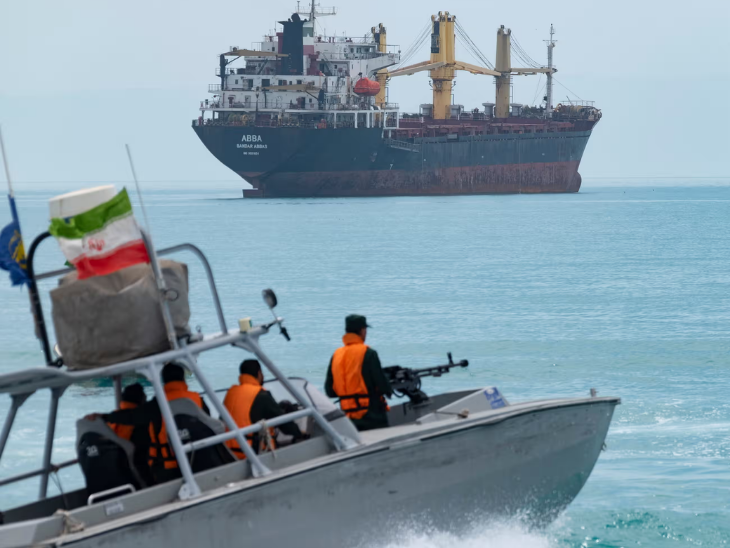
The Iranian military monitors cargo ships as they pass through the Strait of Hormuz.
Why is Hormuz Strait so important for India?
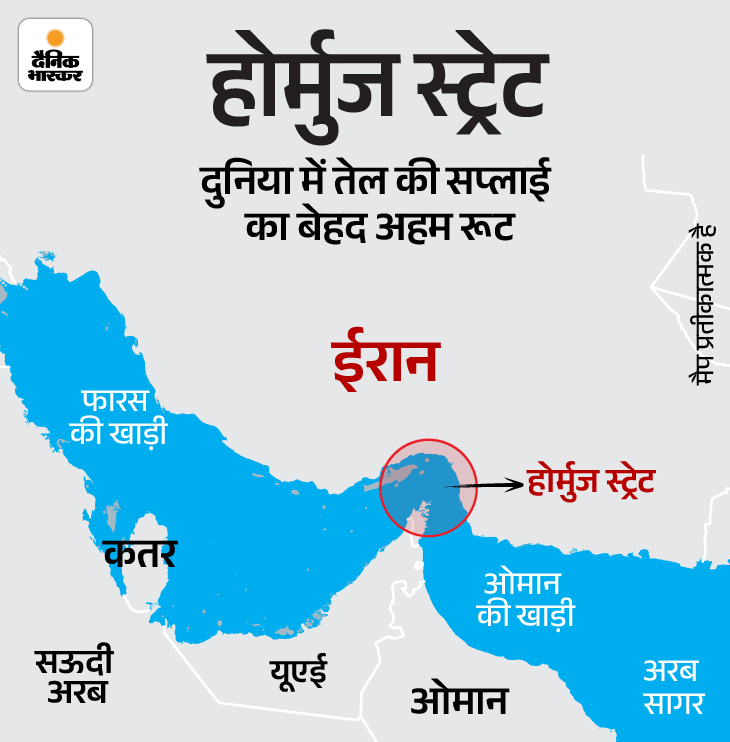
The Strait of Hormuz, located between Iran and Oman, is the world’s most important oil route. India imports most of its crude oil from countries like Saudi Arabia, Iraq, Kuwait and UAE, a large part of which comes through this route.
According to Sumit Ritolia, lead research analyst at Kpler, if Israel attacks Iran’s oil facilities or Iran blocks this route, the supply chain will be completely stopped. This will impact India as well as the global oil market.
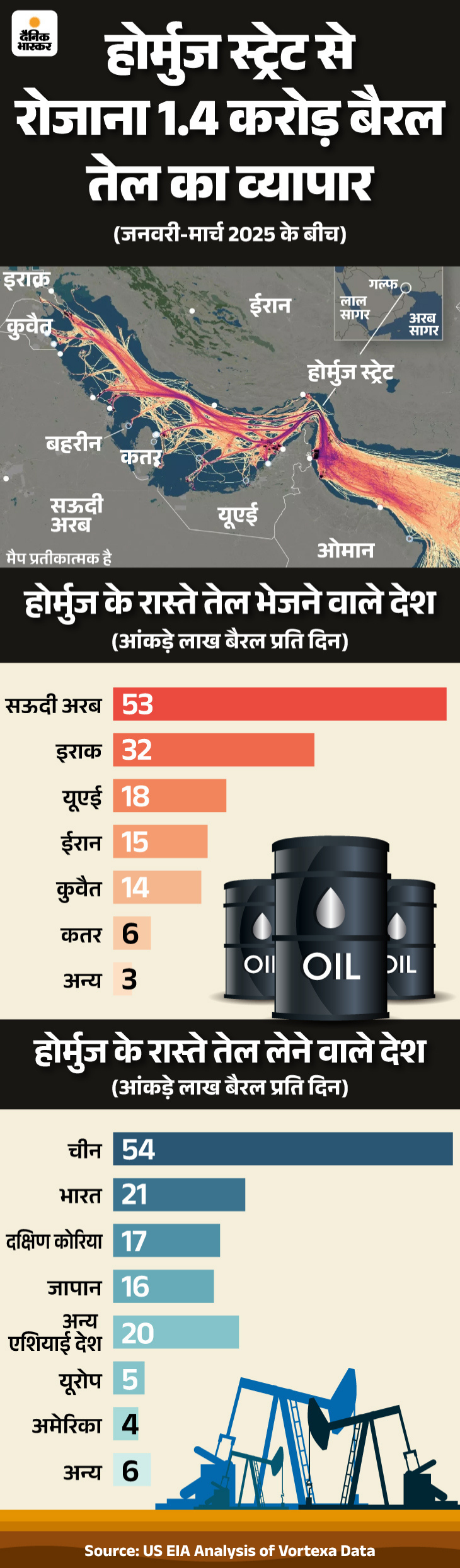
Every day 26 lakh barrels of oil comes to India through the Hormuz Route.
This is because India imports about 26 lakh barrels of crude oil for its needs every day through this route. According to Kepler data, about 50% of India’s total monthly oil imports in January-February came via Hormuz. This figure was 40% in November-December 2025, which has now increased.
Sources say that if the route of Hormuz is closed, India may consider other options. This includes Saudi Arabia’s East-West Pipeline and UAE’s Abu Dhabi Crude Oil Pipeline. Both these pipelines have been built for this purpose so that oil supply can be continued without using the route of Hormuz.
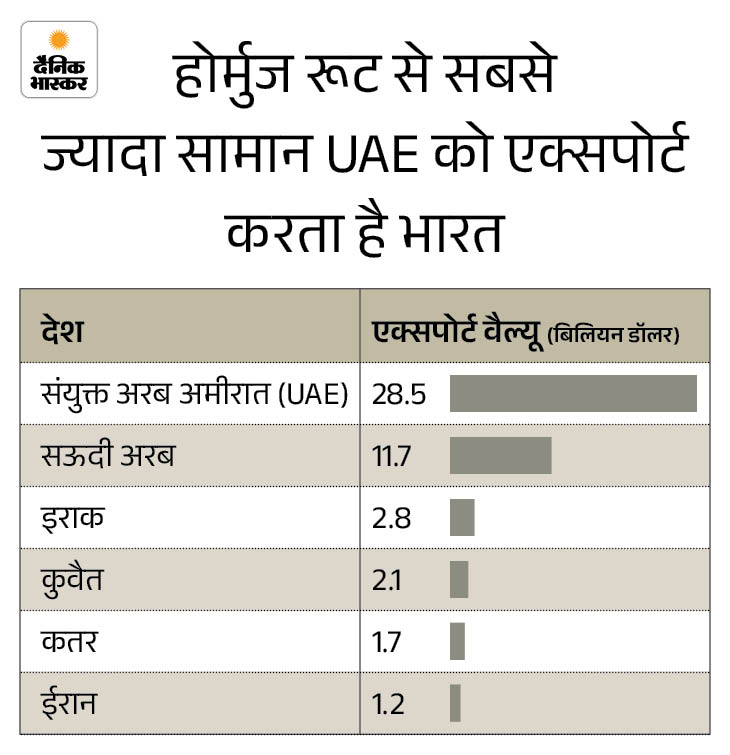
India’s 10% non-oil exports also in trouble
Not only oil, India’s trade is also in trouble due to the war between Iran and Israel. According to a report, more than 10% of India’s total non-oil exports go through the Strait of Hormuz. It also includes basmati rice, tea, spices, fresh fruits, vegetables and engineering goods. Most of the exports to West Asian countries (GCC countries) are through this route. Due to closure of routes or cost of freight transportation, the cost of Indian exporters will increase and Indian goods will become expensive in the global market.
India has recently exported non-oil goods worth about $47.6 billion to Gulf countries whose trade depends on the sea routes connected to the Strait of Hormuz. This accounts for about 13.2% of India’s total non-oil exports of $360.2 billion. These figures show that if there is any interruption in the supply through these routes, then how big an impact it can have on India’s trade.
Indian stock market may fall due to increase in crude prices
Crude oil has always been a sensitive factor for the Indian stock market. If Brent crude prices cross $80-85 per barrel due to Iran-Israel tensions, India’s stock market may see heavy selling. On Friday, the price of Brent crude oil increased by 2.87% to $ 72.87 per barrel.
Sectors like paint, tyres, aviation and logistics, which are dependent on crude oil, will have a direct impact on their margins. Foreign Institutional Investors (FIIs) are already withdrawing money from the Indian market, so this war can further intensify geo-political tensions.
Gold and silver prices may also rise
In times of uncertainty, investors withdraw money from the equity market and turn to safe investments like gold and silver. Commodity experts believe that due to the Iran-Israel war, gold and silver prices may touch new highs.
If America gets directly involved in this war, the demand for gold against the dollar will increase further. Both industrial and investment demand for silver is expected to increase, due to which it can become a source of better returns for investors in the coming times.
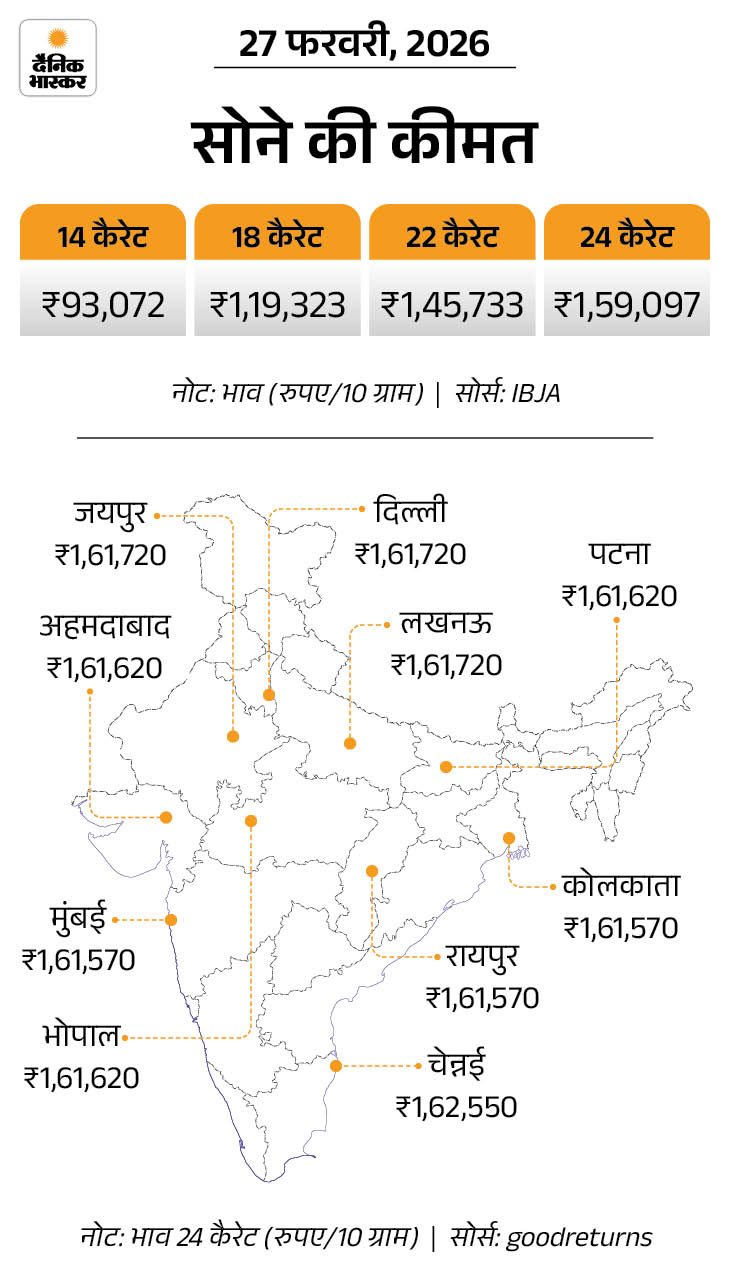
10 grams of gold is being sold at ₹ 1.59 lakh and silver at ₹ 2.66 lakh/kg.
A day earlier on Friday (February 27), there was a rise in the prices of gold and silver. According to India Bullion and Jewelers Association (IBJA), 10 grams of 24 carat gold rose by Rs 1,075 to reach ₹1.59 lakh.
Earlier on Thursday, its price was Rs 1.58 lakh per 10 grams. At the same time, one kg of silver has increased by Rs 6,033 to reach ₹ 2.66 lakh. Earlier on Thursday its price was Rs 2.61 lakh per kg.
Fear of increase in inflation due to war
If crude oil becomes expensive, then the possibilities of reducing the prices of petrol and diesel in India will be lost. Due to fuel becoming expensive, transportation costs will increase, which will have a direct impact on the prices of fruits, vegetables and other essential commodities. This may increase the retail inflation rate.
Market experts say- current situation is wait and watch
Market experts say that the current situation is one of wait and watch. The direction of the global market will depend on what Israel’s next reaction will be. If Israel only targets military targets, the market may recover quickly. If oil refineries or the Hormuz Route were targeted, it could be a sign of a long-term economic recession.
Know about the Strait of Hormuz..
What is the Strait of Hormuz?
The Strait of Hormuz is a narrow waterway that connects the Persian Gulf to the Gulf of Oman and further to the Arabian Sea. Iran is adjacent to it to the north. In the south is Oman and United Arab Emirates i.e. UAE. All the oil producing countries are around it. Therefore, oil is supplied throughout the world through this aquatic route.
The Strait of Hormuz is about 167 km long. Both its mouths are about 50 km wide, while the narrowest part is about 33 km wide. It has a 3 km wide shipping lane for inbound and outbound maritime traffic.
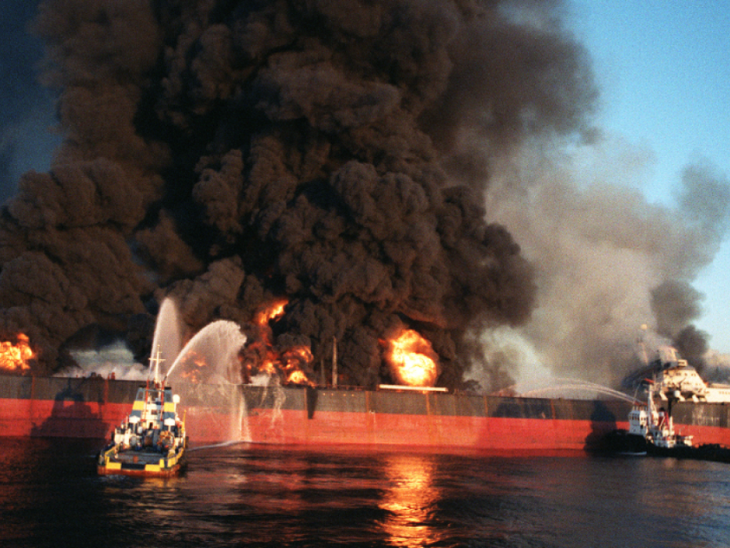
On 6 December 1987, when Singapore’s Norman Atlantic ship reached the Strait of Hormuz, it was attacked by an Iranian warship. After this the ship caught fire.
Why is the Strait of Hormuz so important?
According to America’s Energy Information Administration i.e. EIA, about 20% of the world’s total petroleum passes through the Strait of Hormuz. Every day approximately 17.8 million to 20.8 million barrels of crude oil and fuel goes through this route. According to the International Energy Agency i.e. IEA, Iran itself exports 17 lakh barrels of petroleum through this route every day. Commercial ships passing through this route are protected by a contingent of the US Navy.
Apart from Iran, other Gulf countries like Iraq, Kuwait, Saudi Arabia and UAE also export most of their oil through this route. Most of this is exported to Asian countries. In 2022, 82% of the total oil passing through Hormuz went to Asian countries.
————————–
Read this news also…
America-Israel attack on Iran, 40 girl students killed: Iran also fired missiles at Israel-Dubai, attack on American military base in Qatar-UAE

Israel attacked many cities including Iran’s capital Tehran on Saturday morning. According to Irna News Agency, 40 girl students were killed in these attacks in southern Iran. While 45 are injured.
In response to this, Iran has also started retaliatory attacks on Israel. According to media reports, Iran retaliated by firing about 400 missiles. Read the full news…