

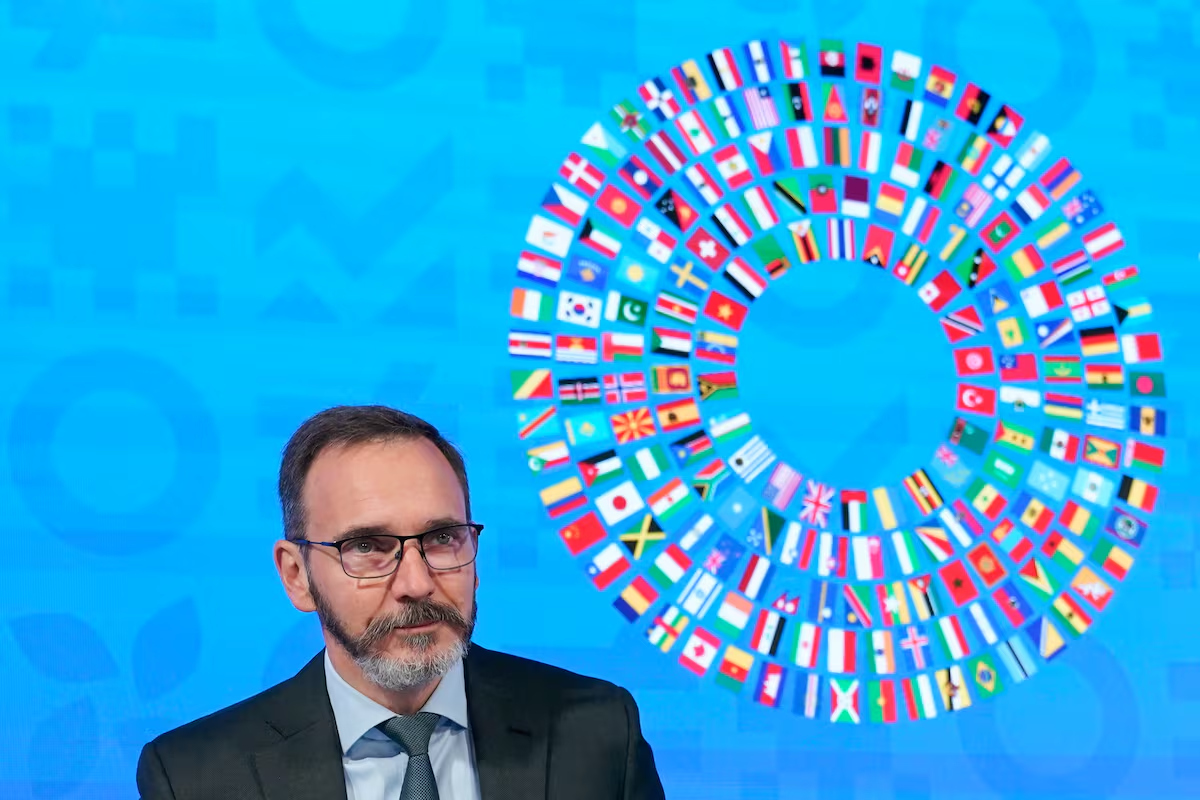
The International Monetary Fund is one of those great symbols of the international economic order founded after the Second World War, champion of multilateralism and free trade, under the leadership of the United States. Now the leading power—and, by the way, the Fund’s largest shareholder—is turning that same order upside down. When the Frenchman Pierre-Olivier Gourinchas (Montpellier, 57 years old), chief economist of the institution, spoke to EL PAÍS last Monday in Brussels, Donald Trump threatened Europe with more tariffs if it does not achieve the sovereignty of Greenland. The threat is raining on a trade war that began in 2025, despite the fact that the global economy shows resistance, as reflected in the latest IMF projections.
Ask. You have just called to avoid a tariff escalation between the United States and Europe in the wake of the Greenland conflict, but,How to respond to Donald Trump’s Administration?
Answer. Our job is not to give advice about retaliation. What we can do, in general, is warn of the dangers to the global economy and stability that a full-blown trade war entails. We have the example of the interwar period, after the Great Depression, when countries turned towards protectionism, began with tit for tat and foreign trade collapsed, which greatly aggravated the crisis. There are always trade disputes, but they must be resolved through consensual mechanisms; tariffs should not be used as an economic weapon.
P. Although, in 2025, tariffs have not been as harmful as feared.
R. Yes, they have caused damage, but other elements have compensated for it. In addition, countries reached trade agreements and the average final tariff remained at 18.5%, below projections, and the private sector showed tremendous adaptability, redirecting its supply chains. Global trade remained buoyant despite the trade war, but the long-term effect is greater, as you lose efficiency and your costs rise, it is something we expect. In the end, The United States is the one paying those tariffs, the data shows. You have to think of them as an internal tax. Furthermore, now we could have more disruptions, the mere uncertainty can affect activity.
P. However, the United States will be the most dynamic economy in the developed world in 2026, according to the latest forecasts. Is it fair to say that, overall, the Trumpeconomy has it worked?
R. Tariffs have hurt, but there have been factors that have pushed in the opposite direction, such as the boom technological, which has been a key factor in 2025 and will be in 2026. Fiscal policy has been expansive and the Federal Reserve has been lowering rates despite the fact that inflation remains close to 3%. Tariffs have raised inflation and people are very concerned about commodity prices. Policies that would increase demand in the economy and lead to more sustained inflation are not necessarily good policies from the point of view of the entire stability of the US economy.
P. Is the White House’s attempted interference in the Federal Reserve seen as a red line for the IMF?
R. The independence of central banks is absolutely criticalis one of the most important lessons of recent years. If we look at what the inflation episode of the 1970s was like and what it has been like now, we see that there was a very different dynamic and it is due to the credibility of the central banks, which allowed disinflation to proceed between 2021 and 2024 without causing major recessions. That credibility came from the confidence that banks could provide price stability, and that confidence was due to their ability to deploy without interference all the tools at their disposal to achieve this. If that credibility is lost, inflation expectations become unanchored, meaning more inflation is expected, and that leads to more volatility in the foreign exchange market, more macroeconomic instability, and less growth.
P. The world has experienced strong shocks since 2020 — the pandemic, the price spiral, the invasion of Ukraine, the rise in tariffs — without major recessions. Do you think there is a paradigm shift, that capitalism has become more resilient to the shocks And that, with adequate stimuli, major crises can be avoided?
R. It would be dangerous to think that. There has been resilience, objectively. Where there has been the most has been in emerging markets, and not only with the pandemic, but in the last 20 years. Before, they were very vulnerable to the behavior of advanced economies and financial markets. This time, rates rose from zero to 5% in the United States and other countries and there were no major crises in emerging economies. They have become more resilient, they have improved their economic policies, their monetary policies and how they manage their fiscal policies. If you look at both developed and emerging economies, to deal with the Covid pandemic, a typical wartime volume of resources was deployed, equivalent to 10 or 15 percentage points of GDP in one or two years, just to support businesses, households and banks. That certainly worked, but you can only do it once. Now we must build that fiscal space. Public incentives can be a great help, but you need to be able to count on them. And that is not clear in many places, if some countries now needed to deploy aid for 10% or 15% of GDP, I am not sure that the markets would follow them.
P. What specific problems do you see in the eurozone, which has also avoided recession, but not slackness?
R. Well, growth has been relatively robust, from 1.4% last year, 1.3% is expected in 2026 and another 1.4% in 2027. The 2026 projection has been improved due to Germany’s public investment plan and defense plans. Spain is also one of the positive points of the euro zone. But potential growth is too low and we see the gap that has opened in terms of productivity and production per capita with respect to the United States. And that is a homegrown problem, it has nothing to do with external forces. That’s what they point out the Draghi and Letta reports. The single market must be deepened, there are still many barriers that prevent integration and economies of scale are not generated. The capital market union must play a role. The region as a whole has large amounts of savings and current account surpluses, it is saving more than it invests. The question is: are these savings going to innovation? Do they fund future unicorns? If you look at the last 25 years, things are not going very well in that regard.
P. He highlights Spain as a positive point on the European panorama, but there is an internal debate about whether growth is too extensive and unproductive.
R. There has, of course, been a contribution to growth that comes from the increase in the workforce, largely due to the arrival of foreigners, but another part that is also due to the employment rate, which has tended to be quite low in relation to other countries. We don’t just see extensive growth. In the last two or three years there has been an increase in productivity and some convergence with respect to other European economies. These elements should obviously be favored and more should be invested in them.
P. And what are your projections regarding these variables in Spain?
R. The contribution of the increase in the workforce and tourism to growth, which have been important drivers, will moderate. We expect a slowdown in GDP in 2027, from 2.3% this year, to 1.9%. Potential growth stands at 1.7%, which is higher than in the rest of the euro zone, although that percentage also reflects relatively positive labor growth, and more can be done.
P. We have not approved new General Budgets for more than two years. Do you see this as a problem for economic policies?
R. The budget plans that have been shown to us, which are the same as those shared with the European Commission, seem reasonable in terms of the fiscal consolidation that is taking place in Spain and other countries. Maybe it could be sped up a little, but the magnitudes seem correct from our perspective.
“Venezuela has a great opportunity before it and the Fund is ready to help”
P. What should be done now in Venezuela, from the point of view of economic policy?
R. Venezuela is going through a situation of economic collapse. Some eight million people have left the country in recent years, there is no budget revenue, the price of oil is relatively low, inflation is extremely high and a portion of the Government’s external debt has gone into default. The good news is that, when an economy is collapsing, once you are able to do something about it, the situation can be stabilized fairly quickly. You can think about solving some of the debts, stabilizing its oil industry… We have seen it in other countries.
P. And now there is a good opportunity to do it?
R. Now there is a good opportunity. We will have to see if the current authorities are willing to take that path. The IMF is not now involved in discussions with Venezuela because its government is not recognized, but we are prepared and, if the situation changes at any time, we will be able to help.

