

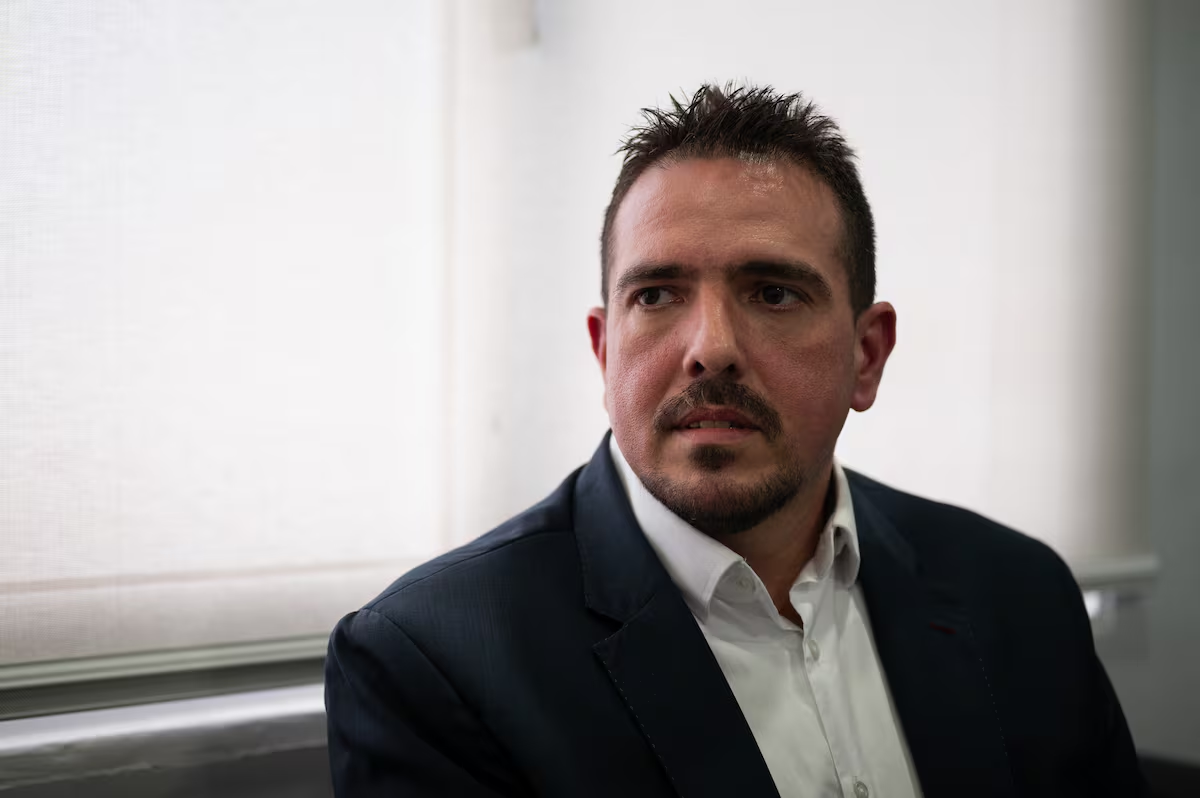
Stalin González appears on the other side of the screen in a white shirt and blue jacket. He does not have the personality of expansive politicians, he is more of a political operator, a negotiator. Practice discretion, a quality necessary to do opposition to Chavismo from within Venezuela. He does not read what they write about him on social networks so as not to lose “friends” who do not understand that he has participated, as a national deputy, in the institutions that until two weeks ago Nicolás Maduro completely controlled. His relationship with the entourage of María Corina Machado, the leader with the greatest political capital in the opposition, is rather scarce.
Stalin has advocated at this time to achieve democracy through negotiation with Chavismo; Machado, with the intervention and isolation of the regime. That difference has created a schism between them. In the end, neither one thing nor the other has happened. Maduro was forcibly overthrown on January 3, true, but Chavismo, through Delcy Rodríguez, continues in power.
P. Are we in a period of transition towards democracy?
R. No.
P. Because?
R. We have to build a road until we get there. An election is part of that process, but not the end. For there to be a transition, we have to return to democracy and that has to be gradually.
P. How and who governs Venezuela right now?
R. Chavismo is now vulnerable. Those who are there now are also vulnerable. The gringos only took Maduro and decided that they would stay in power. I see the matureness doing what he has to do to survive. The one who seems to lead the way is Donald Trump (president of the United States) and they have to do things that they refused to do before.
P. Like which ones?
R. The nucleus of power has been reduced, now it is the Rodríguezes (Delcy Rodríguez and his brother, Jorge) and Diosdado Cabello (Minister of the Interior who controls the Chavista bases and the armed militias). They know they have it difficult. It has been 27 years in power and we are here because they have not recognized the other, for wanting to annihilate the opposition, for not listening to the people.
P. In what period does it seem reasonable to you that there be elections?
R. Without Maduro, there is a need for a presidential election. I couldn’t tell you when they will be, whether in three, six months or whenever. Politics is the art of the possible. We have to build that path. We must stabilize the country, improve the economy, but then we must create institutional spaces for this to end well.
P. Can Trump, someone who undermines democracy in his country, lead Venezuelan democracy?
R. Venezuelans have to drive it. Obviously, The United States took action (the capture of Maduro after a bombing in Caracas) that influenced the construction of this new political moment. But we have to conduct this process in Venezuela.
P. Washington ultimately closed itself to negotiating with Maduro. Now he does it with Delcry Rodríguez, who has Trump’s endorsement. The director of the CIA has visited the new president. We are in a scenario that was unthinkable until recently.
R. Chavismo is pragmatic and wants to stay in power. They can make a refreshing, different speech, but the wear and tear is very great. Hugo Chávez tried to diversify his businesses, but the main partner was always the United States. Chavismo was based on a barrel of oil at $120. The expropriations and management of the oil industry was Chávez’s legacy. This policy is already economically and politically unviable. They bankrupted this country despite having so much income. The level of poverty that exists, nor the state of services, nor how we live is not justified.
P. And what is Chavismo going to do now?
R. He is going to try, with the new oil revenues, to do better management to be competitive in an election. I find it difficult for him to win a presidential election. His wear and tear in power has been very great.
P. Delcy Rodríguez says that it is time to “not fear” contradiction
R. Within Chavismo there is discussion about what they are doing. For many years they fueled criticism of the United States. Now they dance to the music that the gringos play for them in order to stay in power.
P. There are many differences between opponents who live in the country and those who are outside. Can there be a reconciliation?
R. If you have to talk to María Corina, I will always be willing to do it. If I talk to Chavismo, how can I not talk to them? The issue is that, just as Chavismo seems to be reducing its arrogance after January 3, the opposition that is outside should also lower it and stop believing itself to be the owner of the truth.
P. Do you fear that when this opposition returns with a harsher tone there will not be room for a debate where the differences from anti-Chavismo are respected?
R. Today’s Venezuela is not waiting for a radical message. Being radical from Miami, Washington or Madrid doesn’t seem so brave to me. Today’s Venezuela wants something else. The truly brave thing is to try to build an agreement. It is not about turning the page or forgetting what happened, but about looking to the future. Here there is Chavismo, there is a more intransigent opposition, but in the middle there is a country that wants to live in peace, tranquility, in democracy. And be able to give your opinion.
P. You are one of the few opponents that the regime tolerates. Have you had to censor yourself?
R. With Maduro it was not self-censorship, but one had to say things without being rude. What happened in the last 15 days has made this change a little, although not completely. The fight is for it to really change. There are still complaints in the interior of the country that in alcabalas There are police officers who check phones to see political opinions. That has to stop. There is a different atmosphere, but it is not the best. I went to Miraflores ten days ago, I listened to Delcy Rodríguez and I told her that the political prisoners had to be released; I gave him the list. That seems braver to me than standing in a square outside the country to ask for his freedom. Here there are those who believe that politics is only likes y retreatsa Roman coliseum where the applause matters and not the country. Courage is not shouting harder.
P. Can Maduro’s fall be attributed to Machado?
P. No. Without personalizing it, it was the same plan from 2019 (first Trump Administration), but with different actors. A plan that consists of not talking to Chavismo and wanting to be a direct threat. It generated popularity, but was politically unviable and failed.
P. Has she done well in share the Nobel Peace Prize con Trump?
R. I have no comments.
P. Do you think Jorge and Delcy Rodríguez could adapt to a transition, becoming fully democratic actors?
R. Don’t know. This is just beginning. They are going to try. I think there is a good opportunity for all of this to begin a process of political change in Venezuela, or a transition towards something more democratic. For now, the government is giving signals.
P. Isn’t Diosdado lace more difficult? Could it be a destabilizing element in this period?
R. Probably, many of the things that are happening would not happen so quickly without Diosdado. It seems that Diosdado understands and understands what is happening in Venezuela better than some of my friends who are abroad.
P. That phrase is very controversial.
R. What is another stripe for the tiger?
https://elpais.com/america/2026-01-17/stalin-gonzalez-el-chavismo-prefiere-bailar-al-son-de-los-gringos-que-perder-el-poder.html

