

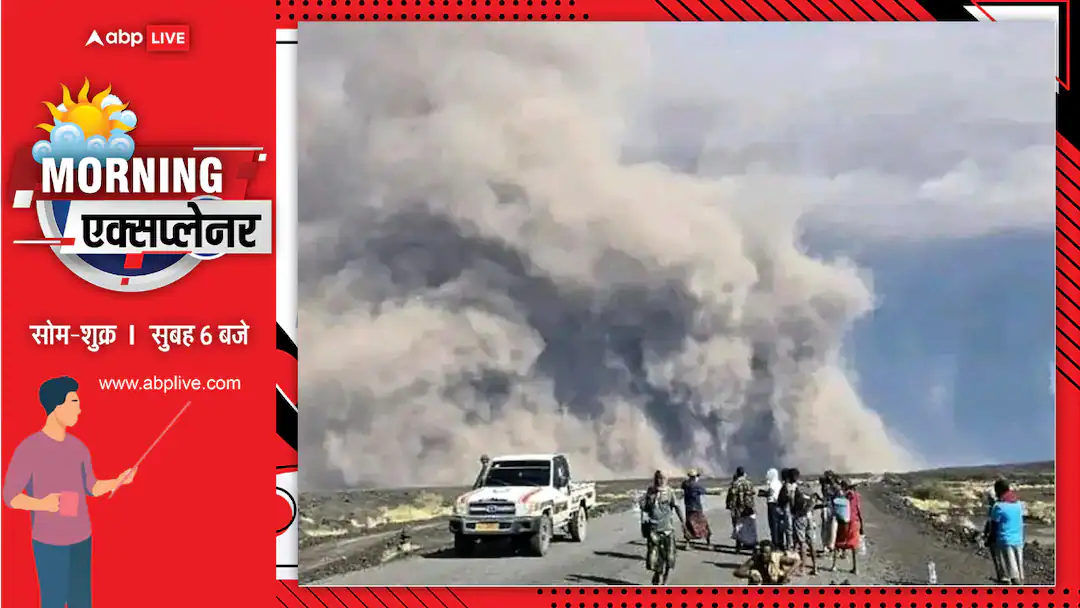
On November 23, a 10,000-year-old volcano erupted about 13 hours away from India. The Haile Gubi volcano exploded in the Afar region of Ethiopia at 8:30 am on Sunday. It was so terrible that its ash clouds are moving towards northern India, due to which the Indian Aviation Authority (DJCA) and airlines have started monitoring flight operations. In ABP Explainer, we understand why volcanoes erupt, how Ethiopia’s volcano erupted after 10 thousand years and what threat it poses to India…
Question 1- Why is volcanic eruption in Ethiopia an extraordinary event?
answer- The smoke arising from the eruption of Haile Gubi volcano reached a height of about 18 km and spread to Yemen and Oman after crossing the Red Sea. It was such an old and quiet volcano that there was no record of it till date. No one has died in this incident, but the governments of Yemen and Oman have asked people to take precautions, especially those who have trouble breathing.
Ibrahim Al Jarwan, Chairman of the Emirates Astronomical Society, said, ‘This event is a rare opportunity for scientists to closely understand a volcano that has awakened after a very long time.’
Although the volcano seems to be calming down, experts say that sometimes after the initial eruption in the Shield Volcano, there may be repeated explosions.
Question 2- What is a volcano and how does it erupt?
answer- Volcanoes are natural cracks present on the earth’s surface. Through these, molten substances like magma, lava, ash etc. come out from the interior of the earth with explosions. Volcanoes are formed due to the collision of 7 tectonic plates and 28 sub-tectonic plates present on the Earth.
Actually, the earth is divided into 7 tectonic plates. These plates under the earth keep moving 2 to 10 kilometers every year. Volcanoes are formed due to this movement of plates…
- First of all, due to the collision of tectonic plates with each other, heat increases and the rocky layer (mantle) below the upper crust of the earth starts melting.
- Due to melting of rocks in the mantle, steam and gases rise up from the depths and melt the rocks above.
- Magma, a thick substance made of molten rocks with a temperature of 1300 degrees Celsius, rises slowly because it is light.
- Magma comes up and starts collecting, which is called magma chamber. Due to excess of gases in magma, cracks appear in the earth’s crust.
- As the pressure increases, magma starts coming out of these cracks, which is called volcanic eruption and magma is called lava.
Question 3- How many types of volcanoes are there?
answer- According to the National Park Service (NPS), an organization that tracks volcanoes around the world, there are about 1600 volcanoes in the entire world. There are three types of volcanoes…
1. Shield Volcano: These are the largest and flattest. Lava is very thin and hot, which flows easily for kilometers. That’s why the slope is very gentle, as if there is a big slope. These volcanoes rarely erupt, but when they do erupt, lava keeps flowing like a river. Like Hawaii’s Mauna Loa and Mauna Kea are the world’s largest volcanoes.
2. Strato Volcano or Composite Volcano: These look like classic sharp and beautiful mountains, which also have snow on them. Lava is thick, so it solidifies quickly and high clouds are formed. These are the most dangerous because they explode very loudly. Ash, stones, gas all jump out of them. Like Mount Fuji of Japan, Mount Rainier of America, Krakatoa, Merapi, Mayon, Vesuvius suppressing Pompeii and Pinatubo. 60-70% of the world’s dangerous volcanoes are of this type.
3. Cinder Cone Volcano: These are the smallest and burst powerfully all at once. Small pieces of lava bounce into the air and a heap is formed. Their height does not exceed 100-400 meters. Like Mexico’s Parisutin Volcano.
Apart from these, there are lava dome volcanoes, which are formed inside or on the mouth of stratovolcano. There are also caldera volcanoes and flood volcanoes from which lava comes out but does not form a mountain.
Question 4- Why can Hailey Gubi volcano become a threat to India?
answer- According to Gulf News, a large amount of sulfur dioxide (SO₂) was also released along with the explosion, which has increased concerns about the impact on the environment and health.
Ibrahim Al Jarwan said that if the volcano is suddenly releasing more SO₂, it indicates that the pressure inside is increasing, the magma is moving and further eruptions may occur.
Airplanes are also facing problems due to the ash spread in the sky. There is a possibility of ashfall over India also, hence flights are being monitored in areas like Delhi-Jaipur.
Officials said two international flights departing from Kochi airport on Monday were canceled due to the volcanic eruption. Ash particles can damage the engine, so caution is being taken as per international aviation protocol.
Actually, the lava that comes out of a volcano is actually molten stone. The lava, ash and gases coming out from it pose a threat to the surrounding area.
- Pyroclastic or hot ash from a volcano is a cloud of fire with a temperature of 800°C. The poisonous gas and stones involved can destroy an area of several kilometers at high speed.
- Volcanic ash contains small glass-like particles, which enter the lungs along with the air and cause difficulty in breathing, accumulate on roofs and cause them to collapse, ruining fields. Because of this, the rising clouds towards India have become a cause for concern.
- When a volcano erupts, gases like carbon dioxide, sulfur dioxide, hydrogen sulphide keep coming out continuously.
- When snow or lakes near a volcano melt and mix with ash, a ‘lahar’ i.e. a big mountain of mud is formed, which runs at a speed of 60 to 100 km per hour.
- Apart from this, there is also a danger of earthquake and tsunami due to volcanic eruption. Eruption of a volcano under the sea creates huge waves in the sea, which is called ‘tsunami’.

