

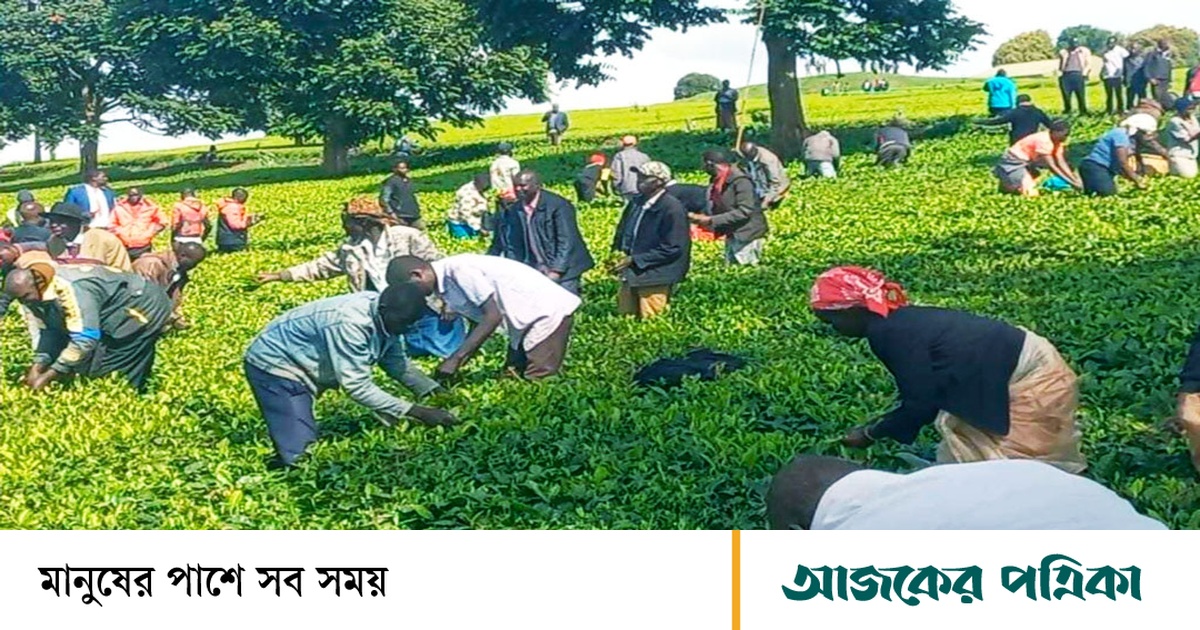
Kenya is the fourth largest tea producing country in the world. There is tea industry in the mountainous area of the Sitoi Estate in the western part of the country. Eastern Produce Kenya (EPK), a British-owned tea-producing company, formed the tea garden by acquiring land in this nandi in the 5th. They have been operating tea gardens in many Kenya regions including Nandis for decades.
A local community has recently begun a dispute over the land owned by Camellia Private Limited, London. The reason for the conflict is the land of gifts.
As a gift in the 5th, Eastern Produce Kenya (EPK) gave some land to the Kimas community. Now the EP is claiming that they gave 202 acres of land. Meanwhile, the Kimasas Farmers Cooperative Association demanded that they were given 5 acres of land, but they were occupied by 5 acres.
In the middle of the tea garden, there are several local residents of Kimasas on this 5 acre land. There they live in the clay and tin canopy cottage. They make a living by raising tea and livestock.
EP has told EP for a long time that they have been operating tea gardens in Kenyan law. But recently, due to the dissatisfaction of the local community, the occupation and political intervention of the local community, their activities are becoming difficult. They call this situation a 'dangerous example'. They complain that such activities are creating long -term risks in the industrial sector.
In response to the claim of Epic, Kimasas Chairman Daniel Bout said, “The British colonists lived here before the British colonies occupied this place around 5am. Refund of 5 acres of disputed land means correcting a historical injustice. '
Bot, his father and grandfather – three men were Epic workers. Standing in the tea garden, Bot said, 'Nothing has happened in these years. Now time, this problem has to be solved. '
The dispute is behind a number of violent incidents that occur in various Kenya tea gardens. The Kenyan Tea Production Association (KGA) said in a statement that a farm of the Sri Lankan -owned Brown Plantation was attacked last January and hundreds of eucalyptus trees were removed. The criminal parties in the political asylum are behind the attack on these lands in Sitoi.
The statement also said that due to these instability, EPK is suffering more than $ 2 million per month. About one-fourth of Kenya's export earnings are threatening the tea industry. The source of livelihood for 3 million people is in danger.
Concerned people say these attacks are a reflection of the disappointment of the failure to solve the land occupation of the colonial era.
Lawyer Joel Kimutai Bosek has sued the tea company and the UK government on behalf of the local community. However, the case did not succeed. “I tried a lot to move on to the legal system, but did not succeed,” he said. I think the new or future generations will be more aggressive. '
According to a UN report from 2021, the British occupied large quantities of land in Kenya for 3-5 years in the colonial era, most of which became tea gardens.
Kenya became aware of this colonial problem around the 21st. The National Land Commission was formed. Former Chief of the Commission, Samuel Toro, said, “The limited power of the Commission has disrupted its effectiveness. And there was a 'immoral relationship' between tea companies and political elites.”
According to the Constitution of Kenya 20, the lease of the previous 5 -year -old land of tea companies was reduced to 5 years. But the government has failed to get enough land or financial benefits for the local people using the ownership of the land.
Until 2021, Kenya had a tea garden in James Finley, Britain. Guy Chambers served as Managing Director in this company from 20 to 2022. “The main reason for this excitement is that the big tea garden is owned by foreigners-as the land was once taken from the local community,” he said.
In this regard, no comment was received from the Kenya government. However, companies are demanding that they are conducting activities in compliance with Kenya law. Some politicians are trying to diminish their land ownership by taking advantage of this historic unrest. At the same time, their personal business interests are moving forward.
However, despite all this, the efforts to recover the land of the local community have not been very successful. According to a UN report, it is difficult to take legal action on these lands, as it is becoming a major obstacle to the deadline and government protection system (immunity).
Private Equity Firms, run by Chambers and Tea cultivators in Caricho district last year, jointly paid the CVC Capital-owned Lipton's estates under a plan that transferred full control to the local community in the next two decades.
In the end, the Lipton company sells them to the Estate Brown Company. A Lipton spokesperson said they had chosen a buyer who could help improve the industry. However, the browns company did not respond to the request of the comment.
In a report of 20, the Kenya National Land Commission called on the British government to apologize and compensate to the communities of the Kericho region. However, the British government did not respond directly to the call.
“We are concerned about the attack on tea-farms in Nandi region and we are in touch with the Kenya authorities,” said the Foreign, Commonwealth and Development Office in Britain.
However, EPK is demanding that the ongoing dispute is not about any historical land and injustice, but it is a gift given on the basis of 'voluntary donation and acceptance'. But the Kenya National Land Commission said in the 27th that the Kimas community owns a full 5 acres of land. EPK challenges this claim in court, saying that the evidence that Kimasas has given is fake.
During the court hearing on August 7, 2021, about 20 people entered the disputed land and began to lift the tea leaves, one of whom was a Member of Parliament. The next day, the court issued a ban and ordered them to leave the land. At that time most people were gone, but later many returned. Even Epic attacked cars and staff.
The company said the police did not implement the ban. And the public prosecutor's office said that accusing anyone in the incident could be considered as intervention in the ongoing civil case.
“If we accept such a situation – where the younger generation starts to say that they do not have enough, they want more – then it will become a dangerous example,” said Epic general manager.
The police or prosecutor's office did not respond to the request of the comment.
On the other hand, the leader of the Kimasas community, Bout, said that it was reasonable to occupy the land on their behalf, because no final verdict has been received in this regard.

