

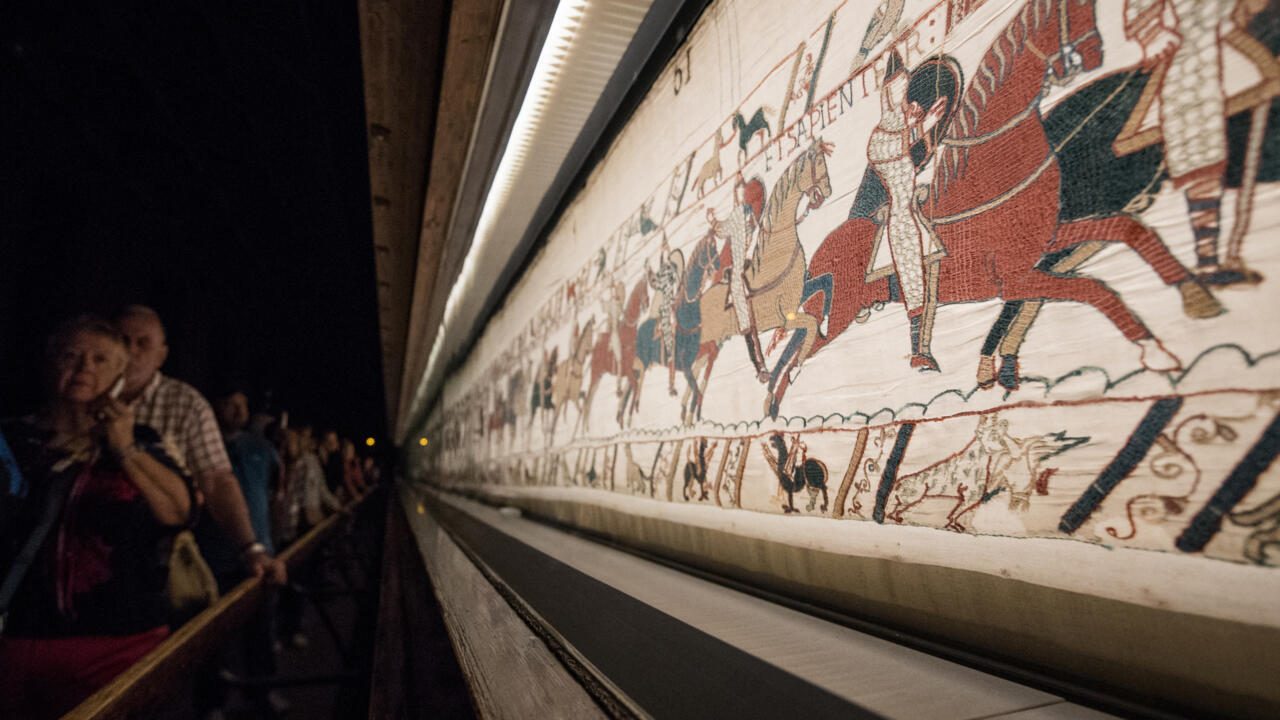

Nearly 1,000 years after chronicling the Norman conquest of England, the Bayeux Tapestry is making history once again. The fragile 11th-century embroidery has arrived in London on an unprecedented loan to the British Museum, prompting delight and concern in equal measure. Celebrated as one of Europe’s greatest medieval treasures, its journey has reignited debates over heritage, diplomacy and the risks of moving delicate cultural artefacts.
Today, many scholars believe its 58 vivid scenes recounting the events leading up to the Battle of Hastings in 1066 were stitched in England. More than nine centuries after William, Duke of Normandy, defeated King Harold, the tapestry has become a symbol of the love-hate relationship between England and France. “The tapestry’s always been a political object,” according to former British ambassador Lord Peter Ricketts, who helped coordinate the loan. “It’s absolutely the founding story of our modern history. It’s the date everybody knows from school: 1066.”
For historians, the embroidery’s enduring appeal lies in its remarkable detail. “You don’t really get many other historical sources that are that evocative of the everyday person’s experience of war,” explains academic Millie Horton-Insch. From royal intrigue and military strategy to horses, ships and soldiers, the tapestry offers an extraordinary window onto medieval life.
A loan decades in the making
Successive British governments have sought to borrow the tapestry over the years, including for Queen Elizabeth II’s coronation in 1953, but France has always refused. A breakthrough came in 2018, when President Emmanuel Macron floated the idea during talks with then British Prime Minister Theresa May. Brexit tensions and the Covid-19 pandemic delayed the project, alongside concerns about the feasibility of transporting such a fragile object.
Yet when the museum in Bayeux, where the tapestry had been on display since 1983, closed for major renovations, the tapestry had to be placed into storage. Closed since September 2025, the site is undergoing a €40 million transformation, with the new museum and annexe due to open in 2027. During a detailed conservation assessment in 2020, experts concluded that the tapestry should no longer hang vertically but instead be displayed along its full length on a gently sloping support, reducing stress on its ageing fibres. The new annexe has been designed to accommodate the tapestry under those specific conditions.
For Bayeux’s residents, its temporary absence is bittersweet. “We live with the Bayeux Tapestry,” said one local. “The whole town lives with it and we’re proud of it.” Others see the loan as fitting for an artwork that illustrates the birth of the Anglo-Norman monarchy. “The English used to come and see it here,” explained tour guide Christèle Tait. “We’re sending it there. We just hope they’ll give it back!”
Conservation concerns overshadow a highly symbolic journey
Amid the cultural and political significance of this priceless artefact, transporting the tapestry has sparked fierce criticism in some quarters. Its most recent scientific assessment identified thousands of stains, holes and tears, prompting recommendations for restoration. Critics argue that moving such a fragile textile is an unnecessary risk, particularly as some technical details of the transport operation were not disclosed in advance by the French Ministry of Culture.
Art historian and journalist Didier Rykner launched a petition opposing the loan in 2025. He argues that experts have never fully measured how the tapestry might respond to vibrations during transport. “We’ve never transported something this fragile,” he says. French authorities, meanwhile, insist that every precaution has been taken, pointing to the custom-built, climate-controlled crate used for the journey. Curators at the British Museum also say the bespoke transport technology developed for the move is unprecedented.
“There is never any movement that goes without any risk whatsoever,” acknowledges lead curator Michael Lewis. “But the procedures put in place have been designed to reduce that risk to as low a level as reasonably possible.”
At a time when public spending on the arts has been cut in both countries, this high-profile Franco-British operation has prompted debate over the role of governments in cultural heritage. Yet while 1066 is synonymous with conflict for generations of Britons, 2026 may be remembered as the year two countries came together to celebrate a shared history – and the extraordinary work of art born from it.

