

New Delhi22 minutes ago
- Copy link
File photo
India has signed 13 Free Trade Agreements (FTAS) and six preferences ie preference agreements with its trading partners to promote goods and services exports. With these agreements, India wants to increase its domestic industry access to global markets.
Since 2014, the country has signed 3 such free trade agreement with Mauritius, UAE, Australia and EFTA (European Free Trade Association). India is actively negotiating on similar agreements with the UK and EU.
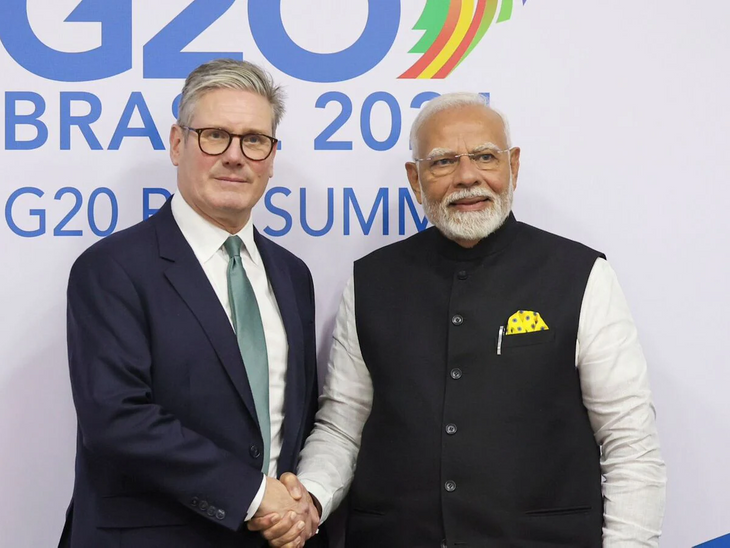
On 24 February, Commerce and Industry Minister Piyush Goyal and UK business and trade secretary Jonathan Rrenalds have announced to resume negotiations for the proposed FTA between the two countries.
This conversation between India-UK is resumed after more than 8 months. Earlier, the talks between the two countries started on 13 January 2022. So far, 14 rounds of talks have been completed.

How many types are trade agreements?
Free trade agreements are given different names according to its nature. These include PTA (preference), RTA (Regional) and BTA (Bilateral). WTO names RTA to all such economic engagements. In PTA some items are made duty free (Indo-Thiland).
At the same time, CECA (Compressive Economic Corporation Agreement) or CEPA (Compressive Economic Partnership Agreement-India-Korea, Japan) or TEPA (Trade and Economic Partnership Agreement)-Its scope is high.

With which countries India have signed these agreements?
India have made trade agents with Sri Lanka, Bhutan, Thailand, Singapore, Malaysia, Korea, Japan, Australia, UAE, Mauritius, ASEAN and EFTA blocks.
According to Global Trade Research Initiative (GTRI), India has shifted its FTA focus to Western partners from East (ASEAN, Japan, Korea) after receiving a deal with large economies in Asia.
India is now giving priority to FTA with UK, EU and US to expand exports and strengthen trade relations with large economies.

What will India benefit from FTA in merchandise trade?
- In FY 2024, the UK was exported for a value of $ 12.9 billion, or Rs 1.12 lakh crore from India. GTRI founder Ajay Srivastava says that this agreement will give further boost to these exports. Because, more than half of Indian products are already exported to UK without less or without tariffs.
- The average tariff on imported goods in UK from India is 4.2%. There will be no benefit from reducing the fee on Indian products of value of $ 6.8 billion i.e. Rs 59,241 crore in the UK, because even without FTA, there is already no tariff in the UK. He said that these products include petroleum products, medicine, diamonds, machine parts, airplanes and wooden furniture.
- At the same time, reducing duty on Indian exports of value of US $ 6.1 billion i.e. Rs 53,139 crore will be beneficial. Such as textiles apparels (shirts, trousers, women traces, bed linen), footwear, carpets, cars, marine products, grapes and mango, these products are less tariffs in the UK.
- GTRI said that in FY 2024, India had a merchandise import of US $ 8.4 billion, or Rs 73,175 crore from UK. A export of 91% of the Total Merchandise Import from UK i.e. US $ 7.6 billion i.e. 66,211 crore rupees comes after the payment of average to high tariff duties in India.
- For example, tariffs on cars are 100% and it is 150% on Scotch whiskey and wine. The simple average tariff in India is 14.6% on the goods imported from the UK. The UK products that are expected to benefit from this FTA include the pressure metals, cars, makeup items, metal scrap, petroleum products, scotch and other alcohol, machinery and integrated circuits.

What is the proposed Bilateral Investment Treaty (BIT) between India and the UK?
Bilateral Investment Treaty helps in promoting and protecting investment in each other's countries. Disputes are also settled in such conversations. India wants the Foreign Firms to use local judicial measures before resorting to international arbitration, but its partners protest against the delay of Indian judicial processes.
GTRI says that there is no decisive research available to show the link between signing of bilateral investment treatment and growth in investment. However, it provides assurance to investors against arbitrary changes in the rules and thus promotes investment.

